index.html
Jesus as «Anathema» (1 Cor 12:3)
in the light of Didache 16:5
in Anna Świderkówna’s translation
web presentation
Wojciech Kosek
This presentation was first shown publicly
in Olsztyn on September 24, 2009,
during the 47th Symposium of Polish Biblical Scholars
(September 23–24, 2009).
This English translation was first published on this website on July 18, 2026.
DOI: 10.5281/zenodo.21430291.
To view the original Polish presentation, please click here.
To go to a selected part of the presentation, please use the table of contents below.
I also invite you to read the article on the same subject, published in September 2011: please click here!
TABLE OF CONTENTS:
- Dear Reader!
- Didache 16:5
- Didache 16:5 in A. Świderkówna’s translation
- The word « κατάθεμα » / « ἀνάθεμα » applied to the Savior has, according to Anna Świderkówna, a positive meaning!
- The etymology of the words « κατάθεμα / ἀνάθεμα »
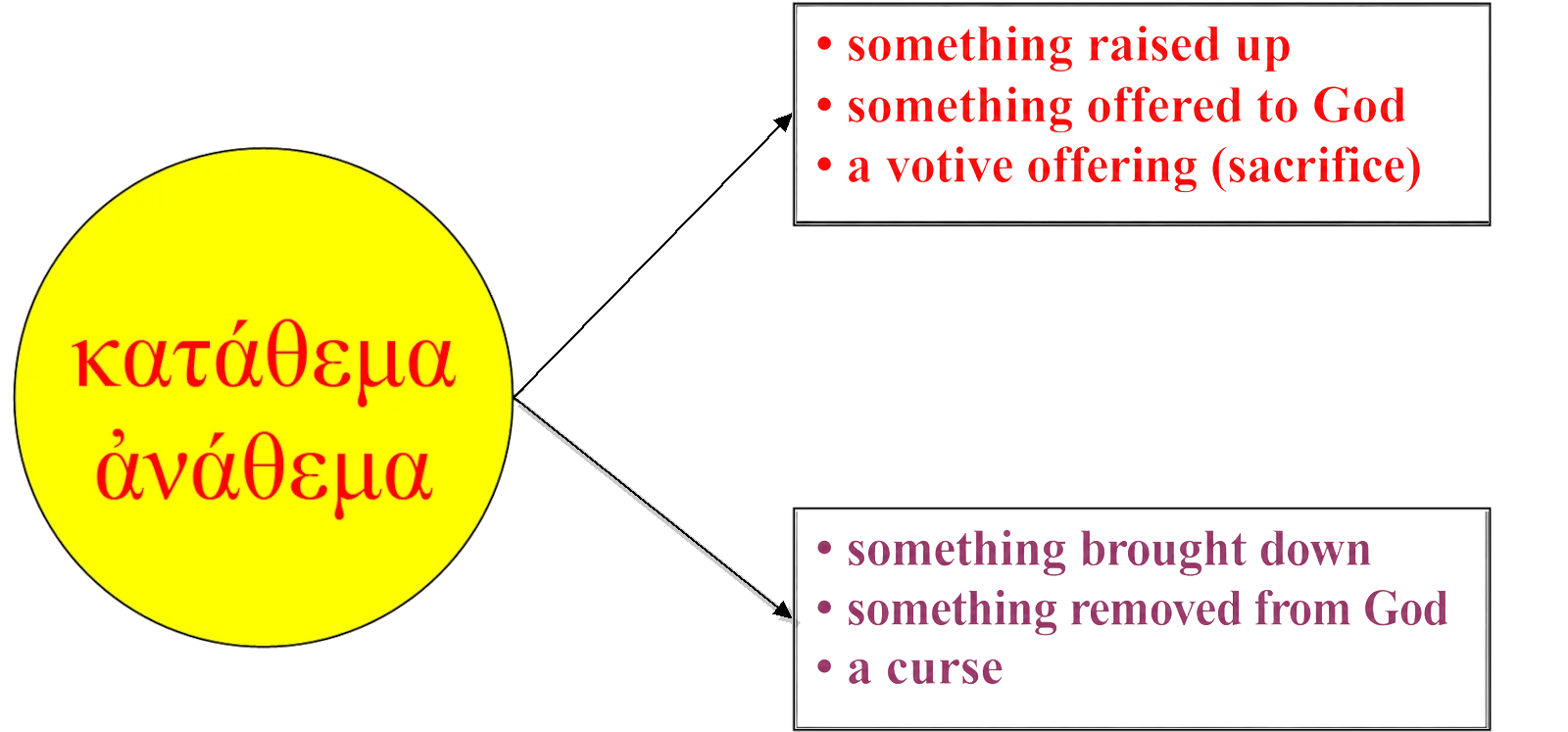
- Two main meanings of the word « κατάθεμα / ἀνάθεμα »
- Two main meanings of the word « κατάθεμα / ἀνάθεμα » with reference to Jesus
- The word « κατάθεμα » in two translations of Didache 16:5:
- The phrase « σωθήσονται ὑπ᾽ αὐτοῦ τοῦ καταθέματος »
- Conclusion from Didache 16:5, that is, from: they will be saved by this Katathema σωθήσονται ὑπ᾽ αὐτοῦ τοῦ καταθέματος
- Conclusion from Didache 16:5, that is, from: they will be saved by this Katathema σωθήσονται ὑπ᾽ αὐτοῦ τοῦ καταθέματος
- 1 Cor 12:3
- Explanation for the next eight slides of the presentation
- The word « ἀνάθεμα » in 1 Cor 12:3:
- The word « ἀνάθεμα » in 1 Cor 12:3:
- The word « ἀνάθεμα » in 1 Cor 12:3: let us note the parallelism of clauses 2 and 3 ( οὐδεὶς ).
- The word « ἀνάθεμα » in 1 Cor 12:3: let us note the parallelism of clauses 2 and 3 ( λαλέω, λέγω ).
- The word « ἀνάθεμα » in 1 Cor 12:3: let us note the parallelism of clauses 2 and 3 ( Ἀνάθεμα, Κύριος ).
- The word « ἀνάθεμα » in 1 Cor 12:3: Conclusion: the group of clauses 2 + 3 in relation to the distinct clause 4.
- The word « ἀνάθεμα » in 1 Cor 12:3: the group of clauses 2 + 3 in relation to the distinct clause 4 — continued.
- The word « ἀνάθεμα » in 1 Cor 12:3: the group of clauses 2 + 3 in relation to the distinct clause 4 — continued.
- A key observation on how pagans understood « πνεῦμα θεοῦ » as a factor of inspiration
- Observation 1: pagans knew the word « θεός » — god. The Bible repeatedly designates the “gods” of the pagans with the word « θεός » (e.g., Acts 7:43).
- Acts 7:43
- Observation 2: pagans knew the word « πνεῦμα » — spirit. Therefore, in the Bible and in Greek literature, « πνεῦμα »:
- Observation 3: pagans knew the expression « πνεῦμα θεοῦ » — spirit of a god — a divine factor of inspiration. Therefore, in the Bible and in Greek philosophy, « πνεῦμα θεοῦ »:
- Observation 4: The Bible contains expressions that specify what kind of spirit of a god ( πνεῦμα θεοῦ ) is meant: good ( ἅγιος ) or evil ( πονηρός ):
- CONCLUSION from the analysis of the expression « πνεῦμα θεοῦ »:
- The expression « πνεῦμα θεοῦ » in 1 Cor 12:3; the group of clauses 2 + 3 in relation to the distinct clause 4: completion of the translation process
- The fruit of the exegesis: the correct translation and explanation of 1 Cor 12:2–3
- Philo of Alexandria
- St Paul
- APPENDIX The grammatical construction of 1 Cor 12:3; the significance of « ἐν πνεύματι θεοῦ ἁγίῳ » for this construction
Description of the contents of this page and its keywords:
Dr Wojciech Kosek: Jesus as «Anathema» (1 Cor 12:3) in the light of Didache 16:5 in Anna Świderkówna’s translation — a scholarly web presentation. Keywords: God, Bible, Jesus Christ, exegesis, Didache 16:5, 1 Cor 12:3, St Paul, First Letter to the Corinthians, Wojciech Kosek, biblical studies, Greek grammar
Anathema_prezentacja_0.html
Dear Reader!
This presentation consists of two main parts:
- Analysis of Didache 16:5 — a writing from the first/second century after Christ.
- Analysis of the First Letter to the Corinthians, 12:3.
I also invite you to read the article on the same subject, published in September 2011: please click here!
This presentation was first publicly delivered by me in Olsztyn on September 24, 2009, during the 47th Symposium of Polish Biblical Scholars (September 23–24, 2009).
Here I wish to express my heartfelt thanks to the Rev. Prof. Waldemar Chrostowski, Chairman of the Association of Polish Biblical Scholars, to whose kindness I owe the opportunity to speak before such a distinguished gathering of priests, religious sisters, and fellow scholars.
No less warmly, I wish to thank the Rev. Prof. Tomasz Jelonek, who introduced me to the Association of Polish Biblical Scholars several years ago and under whose kind supervision I explored the issues concerning the First Letter to the Corinthians presented here in my licentiate thesis.
The main purpose of this web presentation is to show a new, correct translation of Paul’s sentence recorded in 1 Cor 12:3.
The analysis of Didache 16:5 plays an important supporting role here: it helps illuminate the mindset of the Letter’s recipients.
Technical notes for this web presentation:
- If a scroll bar appears on the right side of a given screen (as it does on this screen), it means that additional information has been placed here and is available by scrolling down.
- You can move to individual parts of this merged presentation through the links in the table of contents below or through the “Previous” and “Next” buttons. You can return to the beginning of the presentation by using the “TO PAGE 1” button.
May God bless you!
dr Wojciech Kosek
Anathema_prezentacja_1.html
Didache 16:5
Anathema_prezentacja_2.html
Didache 16:5 in A. Świderkówna’s translation
1 τότε ἥξει ἡ κτίσις τῶν ἀνθρώπων εἰς
2 τὴν πύρωσιν τῆς δοκιμασίας,
3 καὶ σκανδαλισθήσονται πολλοὶ καὶ ἀπολοῦνται,
4 οἱ δὲ ὑπομείναντες ἐν τῇ πίστει αὐτῶν σωθήσονται
5 ὑπ᾽ αὐτοῦ τοῦ καταθέματος.
In A. Świderkówna’s translation [1]:
1 Then humankind will enter into
2 the fire of trial,
3 and many will fall away and perish,
4 but those who endure in faith will be saved
5 by the very One who became a curse [for us].
«καταθέματος» is the genitive of «κατάθεμα», and the word «κατάθεμα» has the same range of meanings as the word «ἀνάθεμα» [2].
Anathema_prezentacja_3.html
The word «κατάθεμα» / «ἀνάθεμα» applied to the Savior
has, according to Anna Świderkówna, a positive meaning!
In Anna Świderkówna’s understanding, this term shows the way in which Jesus accomplished the act of salvation of those who believe in Him:
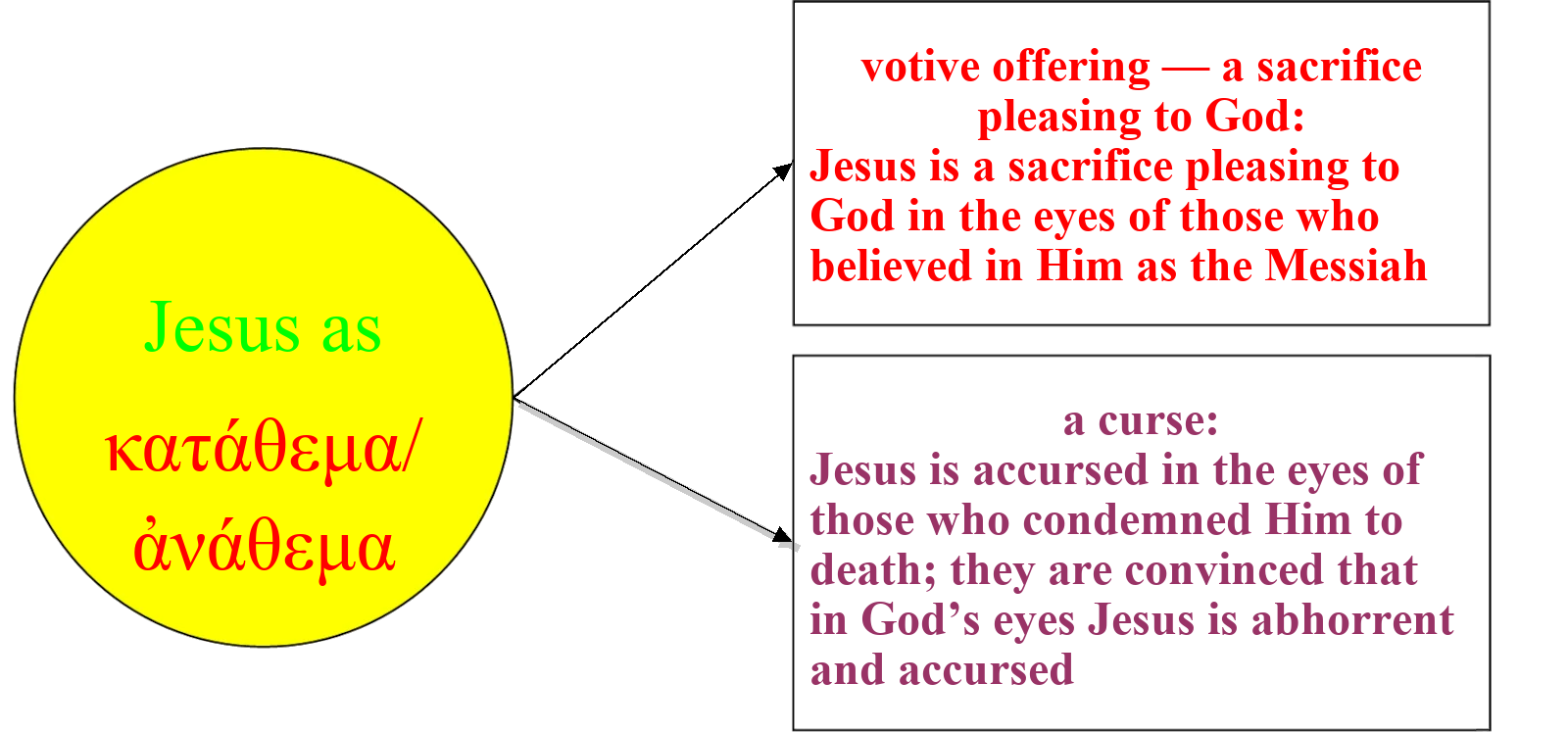
The Savior allowed the Jewish leaders to perceive Him as a deceiver of the people, and consequently as a «κατάθεμα»—an «ἀνάθεμα», a curse. Condemned by them to death on the cross, He offered Himself as an expiatory sacrifice for those who believe in Him as God’s Chosen One.
Note: this is the opposite of the interpretation adopted by the translators of Paul’s statement in 1 Cor 12:3 in the Millennium Bible (discussed below).
Anathema_prezentacja_4.html
The etymology of the words
«κατάθεμα / ἀνάθεμα»
R. Popowski, Wielki słownik grecko-polski Nowego Testamentu [Great Greek-Polish Dictionary of the New Testament], Warszawa 1997:
p. 322: κατάθεμα = κατά + τίθημι + -μα
p. 34: ἀνάθεμα = ἀνά + τίθημι + -μα
Anathema_prezentacja_5.html
Two main meanings of the word «κατάθεμα/ἀνάθεμα»
Anathema_prezentacja_6.html
Two main meanings of the word «κατάθεμα/ἀνάθεμα»
with reference to Jesus
Anathema_prezentacja_7.html
The word «κατάθεμα» in two translations of Didache 16:5:
In the translation by A. Lisiecki [1]:
“Then humankind will enter the fire of trial, and many will fall away and perish, but those who endure will be saved from this curse.”
In the translation by A. Świderkówna:
Then humankind will enter the fire of trial, and many will fall away and perish, but those who endure in faith will be saved by the very One who became a curse [for us].
The essential difference between these translations concerns the phrase:
«σωθήσονται ὑπ᾽ αὐτοῦ τοῦ καταθέματος», including «ὑπ᾽ αὐτοῦ».
| A. Lisiecki: | will be saved from this… |
|---|---|
| A. Świderkówna: | will be saved by this… |
Further analysis will show the correctness of A. Świderkówna’s translation.
Anathema_prezentacja_8.html
The phrase «σωθήσονται ὑπ᾽ αὐτοῦ τοῦ καταθέματος»
The phrase «ὑπ᾽ αὐτου» = «ὑπὸ αὐτου» consists of «ὑπὸ» followed by the genitive.
According to the dictionaries [1], the noun governed by «ὑπὸ αὐτου» denotes the agent of an action, here, the act of salvation expressed by the preceding verb «σωθήσονται».
It should therefore be translated:
σωθήσονται ὑπ᾽ αὐτοῦ τοῦ καταθέματος
will be saved by this Katathema
Anathema_prezentacja_9.html
Conclusion from Didache 16:5, that is, from:
will be saved by this Katathema
σωθήσονται ὑπ᾽ αὐτοῦ τοῦ καταθέματος
In the early Church
calling Jesus “Katathema”:
- was not an insult to Jesus,
- expressed the mystery of Jesus as the Savior, who saves those who believe in Him through the sacrifice of His life.
Anathema_prezentacja_A.html
Conclusion from Didache 16:5, that is, from:
will be saved by this Katathema
σωθήσονται ὑπ᾽ αὐτοῦ τοῦ καταθέματος
«Ἀνάθεμα Ἰησοῦς»
is an acclamation of praise addressed to Jesus the Savior!
Anathema_prezentacja_B.html
1 Cor 12:3
Anathema_prezentacja_B1.html
Explanation for the next eight slides of the presentation
The next eight slides in this presentation analyze 1 Cor 12:3 and show the parallelism between the two clauses. By moving through the successive slides—and, if desired, going back to observe the changes introduced—the reader can follow the exegete’s reasoning toward an understanding of Paul’s statement. Successive words demonstrating the parallelism between these clauses will be marked in green. Finally, a new clause (numbered “4”) will be distinguished as standing in opposition to the parallel clauses (numbered “2” and “3”).
Anathema_prezentacja_C.html
The word «ἀνάθεμα» in 1 Cor 12:3:
- διὸ γνωρίζω ὑμῖν ὅτι
- οὐδεὶς ἐν πνεύματι θεοῦ λαλῶν λέγει˙ Ἀνάθεμα Ἰησοῦς,
- καὶ οὐδεὶς δύναται εἰπεῖν˙ Κύριος Ἰησοῦς,
εἰ μὴ ἐν πνεύματι ἁγίῳ.
In a literal English rendering of the Polish Millennium Bible:
- Therefore, I assure you that
- no one, remaining under the inspiration of the Spirit of God,
can say: «Let Jesus be accursed! ». - Nor can anyone say without the help of the Holy Spirit: «Jesus is Lord».
Anathema_prezentacja_D.html
The word «ἀνάθεμα» in 1 Cor 12:3:
- διὸ γνωρίζω ὑμῖν ὅτι
- οὐδεὶς ἐν πνεύματι θεοῦ λαλῶν λέγει˙ Ἀνάθεμα Ἰησοῦς,
- καὶ οὐδεὶς δύναται εἰπεῖν˙ Κύριος Ἰησοῦς,
εἰ μὴ ἐν πνεύματι ἁγίῳ.
In a literal English rendering of the Polish Millennium Bible:
- no one, remaining under the inspiration of the Spirit of God,
can say: «Let Jesus be accursed! ». - Nor can anyone say without the help of the Holy Spirit: «Jesus is Lord».
Anathema_prezentacja_E.html
The word «ἀνάθεμα» in 1 Cor 12:3:
let us note the parallelism of clauses 2 and 3 (οὐδεὶς).
- οὐδεὶς ἐν πνεύματι θεοῦ λαλῶν λέγει˙ Ἀνάθεμα Ἰησοῦς,
- καὶ οὐδεὶς δύναται εἰπεῖν˙ Κύριος Ἰησοῦς,
εἰ μὴ ἐν πνεύματι ἁγίῳ.
In a literal English rendering of the Polish Millennium Bible:
- no one, remaining under the inspiration of the Spirit of God,
can say: «Let Jesus be accursed! ». - Nor can anyone say without the help of the Holy Spirit: «Jesus is Lord».
Anathema_prezentacja_F.html
The word «ἀνάθεμα» in 1 Cor 12:3:
let us note the parallelism of clauses 2 and 3 (λαλέω, λέγω).
- οὐδεὶς ἐν πνεύματι θεοῦ λαλῶν λέγει˙ Ἀνάθεμα Ἰησοῦς,
- καὶ οὐδεὶς δύναται εἰπεῖν˙ Κύριος Ἰησοῦς,
εἰ μὴ ἐν πνεύματι ἁγίῳ.
In a literal English rendering of the Polish Millennium Bible:
- no one, remaining under the inspiration of the Spirit of God,
can say: «Let Jesus be accursed! ». - Nor can anyone say without the help of the Holy Spirit: «Jesus is Lord».
Note: λαλῶν — from the verb «λαλέω»
λέγει, εἰπεῖν — from the verb «λέγω».
Anathema_prezentacja_G.html
The word «ἀνάθεμα» in 1 Cor 12:3:
let us note the parallelism of clauses 2 and 3 (Ἀνάθεμα, Κύριος).
- οὐδεὶς ἐν πνεύματι θεοῦ λαλῶν λέγει˙ Ἀνάθεμα Ἰησοῦς,
- καὶ οὐδεὶς δύναται εἰπεῖν˙ Κύριος Ἰησοῦς,
εἰ μὴ ἐν πνεύματι ἁγίῳ.
In a slightly modified literal English rendering of the Polish Millennium Bible:
- no one, remaining under the inspiration of the Spirit of God,
can say: «Jesus is Anathema ». - Nor can anyone say without the help of the Holy Spirit: «Jesus is Lord».
Note: the acclamations in clauses 2 and 3 have identical syntax: each consists of two nouns in the nominative
(predicate nominative + subject):
Ἀνάθεμα Ἰησοῦς, Κύριος Ἰησοῦς.
Anathema_prezentacja_H.html
The word «ἀνάθεμα» in 1 Cor 12:3:
Conclusion: the group of clauses 2+3 in relation to the distinct clause 4.
- οὐδεὶς ἐν πνεύματι θεοῦ λαλῶν λέγει˙ Ἀνάθεμα Ἰησοῦς,
- καὶ οὐδεὶς δύναται εἰπεῖν˙ Κύριος Ἰησοῦς,
- εἰ μὴ ἐν πνεύματι ἁγίῳ.
In the author’s translation of the presentation:
- no one speaking in the spirit of a god says: «Jesus is Anathema»
- and no one can say: «Jesus is Lord»,
- unless in the Holy Spirit.
Anathema_prezentacja_I.html
The word «ἀνάθεμα» in 1 Cor 12:3:
the group of clauses 2+3 in relation to the distinct clause 4 — continued.
- οὐδεὶς ἐν πνεύματι θεοῦ λαλῶν λέγει˙ Ἀνάθεμα Ἰησοῦς,
- καὶ οὐδεὶς δύναται εἰπεῖν˙ Κύριος Ἰησοῦς,
- εἰ μὴ ἐν πνεύματι ἁγίῳ.
Author’s translation — continued, slightly changed (added “speaks” in clause 4):
- no one speaking in the spirit of a god says: «Jesus is Anathema»
- and no one can say: «Jesus is Lord»,
- unless [he speaks] in the Holy Spirit.
Anathema_prezentacja_J.html
The word «ἀνάθεμα» in 1 Cor 12:3:
the group of clauses 2+3 in relation to the distinct clause 4 — continued.
- οὐδεὶς ἐν πνεύματι θεοῦ λαλῶν λέγει˙ Ἀνάθεμα Ἰησοῦς,
- καὶ οὐδεὶς δύναται εἰπεῖν˙ Κύριος Ἰησοῦς,
- εἰ μὴ ἐν πνεύματι ἁγίῳ.
Author’s translation — continued, changed again (added “God” in clause 4):
- no one speaking in the spirit of a god says: «Jesus is Anathema»
- and no one can say: «Jesus is Lord»,
- unless [he speaks] in the holy Spirit [of God].
A very important expression occurs three times in the Book of Daniel: πνεῦμα θεοῦ ἅγιον — the holy Spirit of God
4,8: πνεῦμα θεοῦ ἅγιον ἐν ἑαυτῷ ἔχει
4,9.18: πνεῦμα θεοῦ ἅγιον ἐν σοί
Daniel, having the holy spirit of God within him (πνεῦμα θεοῦ ἅγιον), was able to interpret the mysteries conveyed by God through prophetic dreams.
Anathema_prezentacja_K.html
A key observation on how pagans understood «πνεῦμα θεοῦ» as a factor of inspiration
The key point in the analysis of Paul’s sentence in 1 Cor 12:3 is the following observation: both Israelites and pagans understood prophecy as the transmission of words from God, made possible by a mysterious yet real “spirit of God” that acted upon the prophet. This understanding found expression both in the Bible and in the works of pagan philosophers. Many commentators observe that St Paul referred to philosophical concepts, including Plato and Philo of Alexandria [1]. Nevertheless, scholarly studies often overlook how the Corinthians who had converted from paganism (and it is especially to them that St Paul addresses himself in 1 Cor 12:3 — cf. 1 Cor 12:2) understood «πνεῦμα θεοῦ» as a divine factor of inspiration. This omission, however, is not justified, as will be shown in the following slides of this presentation.
See also J. Murphy – O’Connor, Pierwszy List do Koryntian [The First Letter to the Corinthians], in: R. E. Brown, J. A. Fitzmyer, R. E. Murphy (editors of the original edition), W. Chrostowski (editor of the Polish edition), Katolicki komentarz biblijny [Catholic Biblical Commentary], translated by K. Bardski and others, Warszawa 2001, p. 1327: the commentary on 1 Cor 2:14 refers to Philo’s principle, outlined in Quod det., 86; in the commentary on 1 Cor 2:15 it indicates that the Corinthians applied Philo’s principle, contained in Leg. alleg. 1,94.
Anathema_prezentacja_L.html
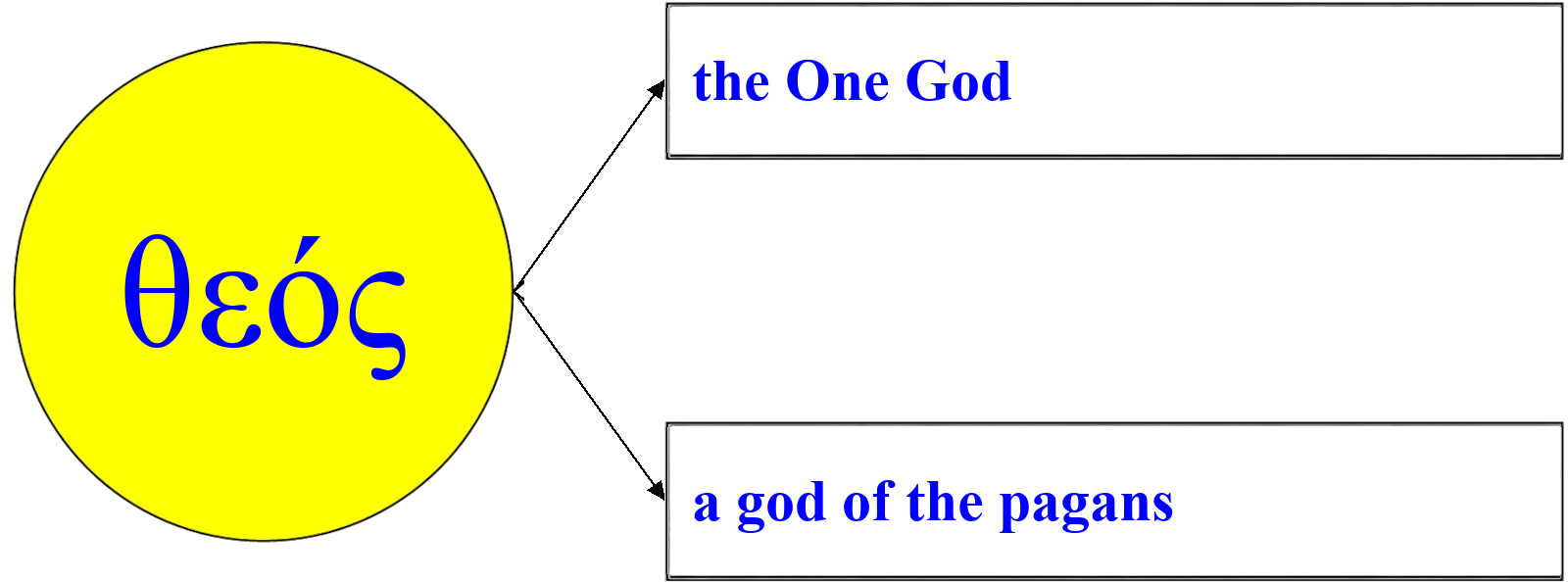
Observation 1: pagans knew the word «θεός» — god.
The Bible repeatedly designates the “gods” of the pagans
with the word «θεός» (e.g., Acts 7:43).
Anathema_prezentacja_X_Dz_7_43.html
Acts 7:43
BTP Acts 7:43 Instead, you carried the tent of Moloch and the star of the god Rephan, the images that you made to worship them. Therefore, I will deport you beyond Babylon.
BGT Acts 7:43 καὶ ἀνελάβετε τὴν σκηνὴν τοῦ Μόλοχ καὶ τὸ ἄστρον τοῦ θεοῦ [ὑμῶν] Ῥαιφάν, τοὺς τύπους οὓς ἐποιήσατε προσκυνεῖν αὐτοῖς, καὶ μετοικιῶ ὑμᾶς ἐπέκεινα Βαβυλῶνος.
Note: the Millennium Bible renders «τοῦ θεοῦ» as “idol,” although the Greek literally means “god.”
Anathema_prezentacja_M.html
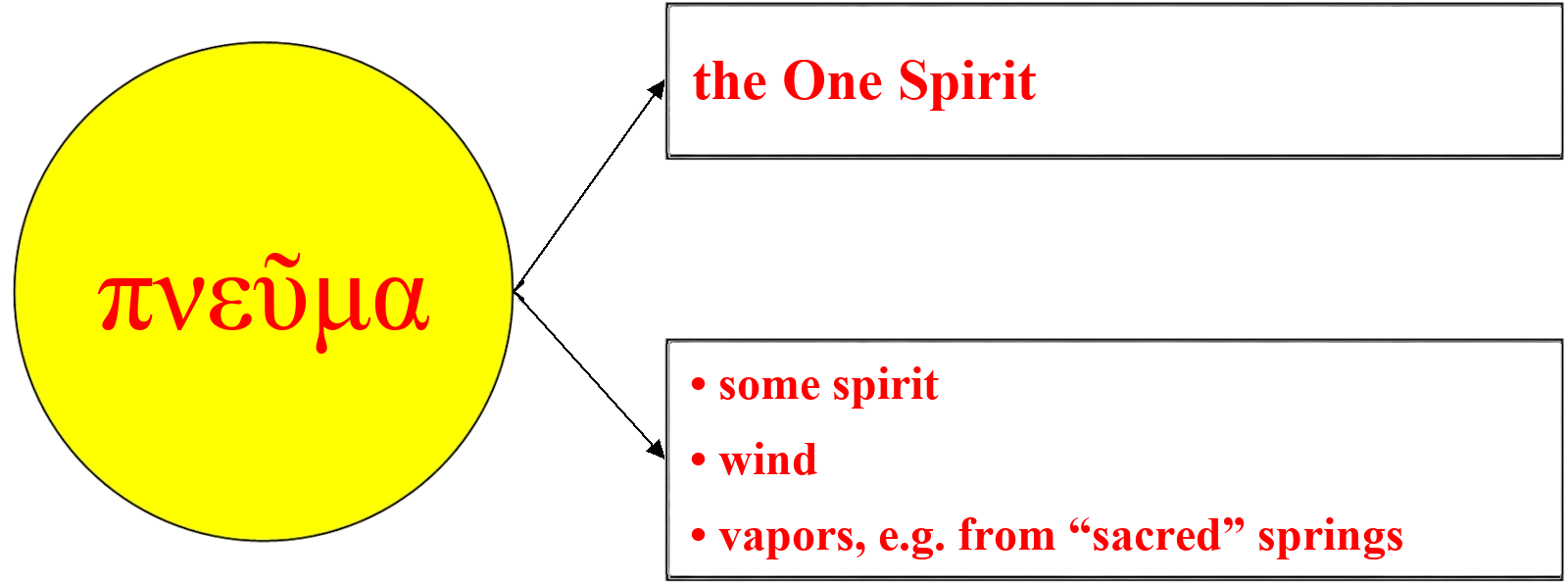
Observation 2: pagans knew the word
«πνεῦμα» — spirit.
Therefore, in the Bible and in Greek literature, «πνεῦμα»:
Anathema_prezentacja_N.html
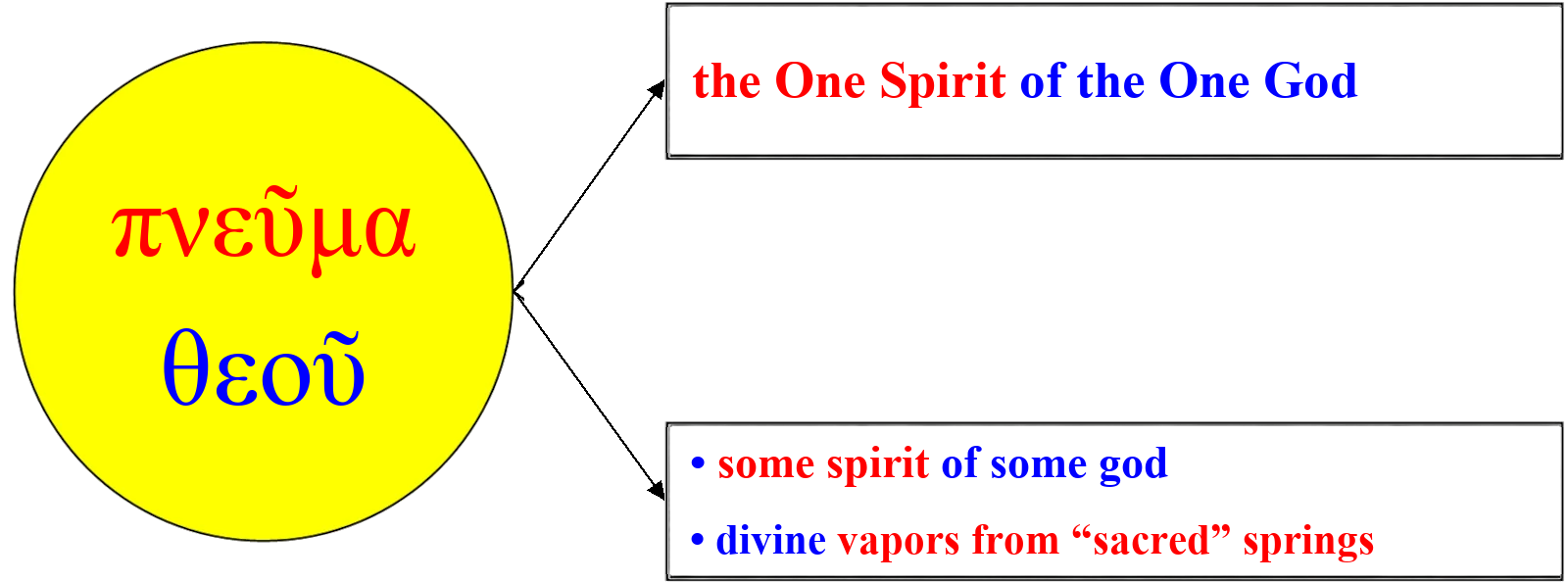
Observation 3: pagans knew the expression
«πνεῦμα θεοῦ» — spirit of a god — a divine factor of inspiration.
Therefore, in the Bible and in Greek philosophy, «πνεῦμα θεοῦ»:
Anathema_prezentacja_O.html
Observation 4: The Bible contains expressions specifying
what kind of spirit of a god (πνεῦμα θεοῦ) is meant:
good (ἅγιος) or evil (πονηρός):
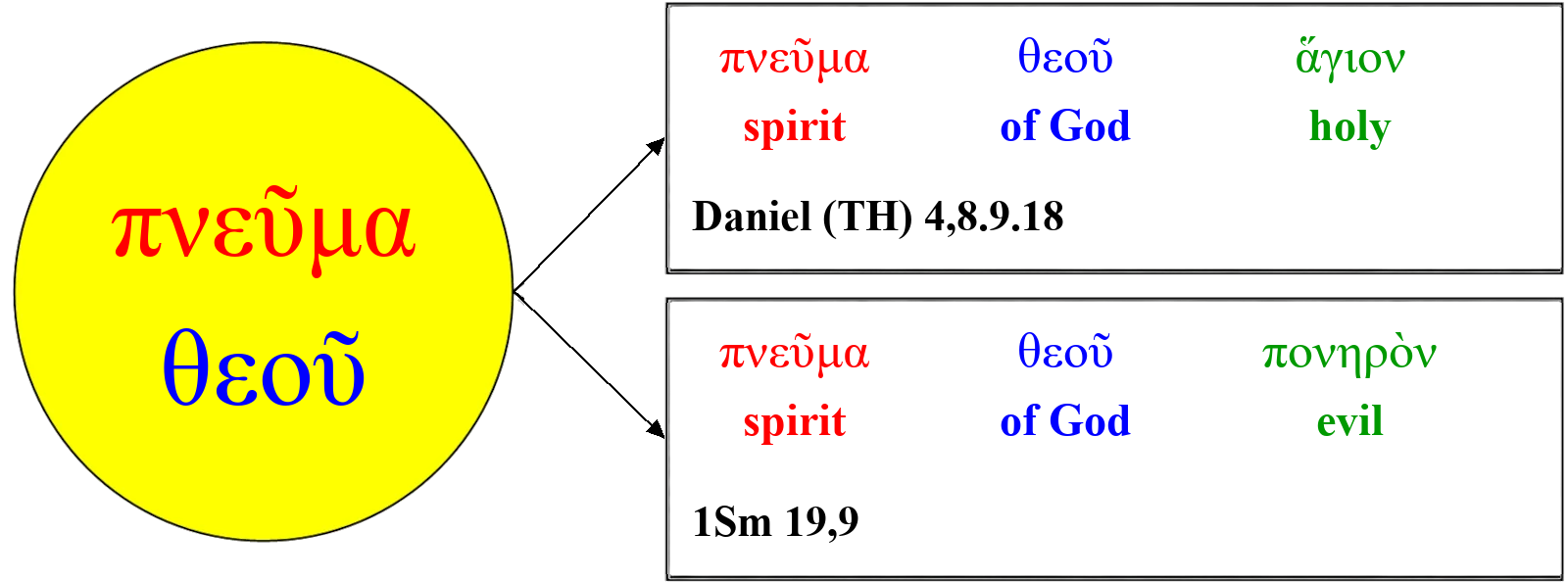
Note on Daniel (TH) 4:8, 9, 18: cf. BibleWorks 6.0. A search was conducted in the BGM text using the search string: 'πνευμα θεος αγιος. The texts found belong to the second of the two parallel versions of the Book of Daniel, designated as Daniel (TH). Both versions are also contained in A. Rahlfs, Septuaginta. Id Est Vetus Testamentum Graece Iuxta LXX Interpretes, Stuttgart 1954³, p. 896. The verse numbering used here is reproduced exactly in BibleWorks 6.0, whereas in Biblia Tysiąclecia, Biblia Poznańska, and other Polish translations, it is somewhat shifted. Moreover, these translations do not take into account all textual versions of the Book. The phrase «πνεῦμα θεοῦ ἅγιον» is rendered in Polish translations as “spirit of the holy gods” and thus carries a different, non-monotheistic sense.
Anathema_prezentacja_P.html
CONCLUSION from the analysis of the expression
«πνεῦμα θεοῦ»:
In the Bible, the expression
«πνεῦμα θεοῦ»
does not always refer
to the Holy Spirit
Anathema_prezentacja_R.html
The expression «πνεῦμα θεοῦ» in 1 Cor 12:3;
the group of clauses 2+3 in relation to the distinct clause 4:
completion of the translation process
- οὐδεὶς ἐν πνεύματι θεοῦ λαλῶν λέγει˙ Ἀνάθεμα Ἰησοῦς,
- καὶ οὐδεὶς δύναται εἰπεῖν˙ Κύριος Ἰησοῦς,
- εἰ μὴ ἐν πνεύματι ἁγίῳ.
Author’s translation:
- no one speaking in the spirit of a god says: “Jesus is Anathema,”
- and no one can say: “Jesus is Lord,”
- unless he speaks in the holy Spirit of God.
Reminder: clause 4 in the translation is based on Dan 4:8, 9, 18, where the expression occurs: πνεῦμα θεοῦ ἅγιον — the holy Spirit of God.
Note: the distinction between the group of clauses 2+3 (containing the key “οὐδεὶς ἐν πνεύματι θεοῦ…” + “καὶ οὐδεὶς…”) and clause 4 (containing “εἰ μὴ ἐν πνεύματι ἁγίῳ”) should be shown against the background of other sentences with an analogous grammatical-logical construction, in which:
- the first clause denies any possibility of performing the act specified in it — here: uttering certain acclamations in the spirit of a god,
- the last clause shows the existence of an exception to that negation — here: the possibility of uttering those acclamations in the holy Spirit of God.
Sentences with an analogous grammatical-logical construction very often contain not only the negations οὐδεὶς… καὶ οὐδεὶς… εἰ μὴ …, but also the same negated element in the clauses before and after εἰ μὴ — in the case of 1 Cor 12:3, this is ἐν πνεύματι θεοῦ (if one takes into account that «ἐν πνεύματι ἁγίῳ» is an abbreviation for «ἐν πνεύματι θεοῦ ἁγίῳ»).
More on this subject is given in the APPENDIX.
Anathema_prezentacja_S.html
The Fruit of Exegesis:
the correct translation and explanation of 1 Cor 12:2–3
Correct translation of 1 Cor 12:2–3:
“² You know that when you were pagans, you were irresistibly drawn toward mute idols. ³ Therefore I make known to you that: no one speaking in the spirit of a god says: “Jesus is Anathema,” and no one can say: “Jesus is Lord,” unless he speaks in the holy Spirit of God.”
St Paul teaches the Corinthians in 1 Cor 12:2–3:
(v. 2:) when you were still pagans, you went to your “gods,” to oracles — there were pagan seers who, under the influence of “divine” vapors (πνεῦμα θεοῦ), rising from “divine” springs, spoke to you in the name of those “gods.” But know that those “gods” are truly mute, that is, they truly do not have a real spirit within them and cannot communicate truth to you. (v. 3:) Therefore, no one who prophesies under the influence of those “divine” vapors and thus under the influence of the “spirit” of those “gods” (πνεῦμα θεοῦ), knows the mystery of Jesus. By contrast, the one who prophesies under the influence of the Holy Spirit, that is, the Spirit of the true and only God (πνεῦμα θεοῦ), knows Jesus, the fullness of His mystery as Anathema (the One who offered Himself as a sacrifice for our sins, who suffered death for us) and as Lord (risen after His sacrificial death, the One who after the Resurrection gives the Holy Spirit to those who believe in Jesus as the Messiah).
To supplement the analyses presented, it is also worth seeing:
- The philosophy of inspiration in Philo (died ca. A.D. 50).
- In St Paul, analogous expressions to πνεῦμα θεοῦ ἅγιον.
Anathema_prezentacja_X_FILON.html
Philo of Alexandria
The expressions «πνεῦμα θεοῦ» (“spirit of a god”) and «πνεῦμα θεῖον» (“divine spirit”) occur in the works of Greek philosophers [1] and, in New Testament times, in the works of the Greek-writing Jewish philosopher Philo of Alexandria [2]. In the work “On the Giants,” Philo presented the fundamental role of the spirit of God in leading a person to mystical knowledge and union with God. Commenting on the Pentateuch, the author notes that only a “spiritual” person (as opposed to a “fleshly” person — a “giant”) can enjoy the lasting presence of the divine spirit.
In sections 22–23, Philo gave two definitions of this mysterious spirit:
- Referring to Gen 1:2: the spirit of God is “air flowing from the earth, the third element hovering above the surface of the water”.
This definition seems to correspond to the common religious experience of pagans: divination performed under the influence of vapors (in Greek described by the word “spirit” — “πνεῦμα” [3]), rising from “divine” springs [4], - Referring to Exod 31:2–3: the spirit of God is “pure knowledge in which every sage participates”.
This definition is close to both Jews and Greeks.
Compare also analogous expressions in: Plato, Axiochus 370c [5]:
“unless a divine spirit dwelt in the soul”
“εἰ μὴ θεῖον ἐνῆν πνεῦμα τῇ ψυχῇ.”
and “ΟΤΙ ΑΤΡΕΠΤΟΝ ΤΟ ΘΕΙΟΝ” (“On the Unchangeableness of God”), in: R. Arnaldez, J. Pouilloux, C. Mondesert, A. Moses (commentary), Les oeuvres de Philon d'Alexandrie, vols. 7–8, Paris 7e, 1963.
See also the Polish translation with notes: S. Kalinkowski, Filon Aleksandryjski, Pisma [Philo of Alexandria, Writings], vol. 2, Kraków 1994.
Anathema_prezentacja_X_Pawlowe_Duch_Swiety_Boga.html
St Paul
In the New Testament, there is no expression “evil spirit of God.” There is, however, the expression “the Holy Spirit of God,” that is, “the Spirit of God who is holy”:
Eph 4:30: τὸ πνεῦμα τὸ ἅγιον τοῦ θεοῦ
The expression “His Holy Spirit” follows the same pattern:
1 Thess 4:8: τὸ πνεῦμα αὐτοῦ τὸ ἅγιον
Both expressions used by St Paul show that the Apostle adopted the Old Testament understanding of the “spirit of God”: the phrase “spirit of God” does not necessarily refer to the Holy Spirit.
Anathema_prezentacja_T.html
APPENDIX
The grammatical construction of 1 Cor 12:3;
the significance of «ἐν πνεύματι θεοῦ ἁγίῳ» for this construction
I. 1 Cor 12:3 and 1 Cor 8:4.
It will be shown here that 1 Cor 12:3 has the same grammatical construction as 1 Cor 8:4.
Both Pauline sentences have: a/ an introduction, b/ two parallel negations (b1/ and b2/), c/ εἰ μὴ, d/ an exception to what is negated before «εἰ μὴ».
1 Cor 8:4:
| a. | introduction: Therefore, concerning the eating of foods that have already been sacrificed to idols, we know |
|---|---|
| b1. | ὅτι οὐδὲν εἴδωλον ἐν κόσμῳ that no idol [exists] in the world, |
| b2. | καὶ ὅτι οὐδεὶς θεὸς and that no god [exists] |
| c. | εἰ μὴ — except |
| d. | εἷς. — One. |
1 Cor 12:3:
| a. | introduction: Therefore, I make known to you that |
|---|---|
| b1. | οὐδεὶς ἐν πνεύματι θεοῦ λαλῶν λέγει˙ Ἀνάθεμα Ἰησοῦς, no one speaking in the spirit of a god says: “Jesus is Anathema” |
| b2. | καὶ οὐδεὶς δύναται εἰπεῖν˙ Κύριος Ἰησοῦς, and no one can say: “Jesus is Lord” |
| c. | εἰ μὴ — except |
| d. | ἐν πνεύματι ἁγίῳ. — in the Holy Spirit. |
Comparing the parallel negations b1 and b2 in both sentences, one sees that the second of the negations adds «καὶ» to «ὅτι οὐδεὶς» or «οὐδεὶς» respectively (in 8:4 «οὐδὲν» is the form of «οὐδεὶς» for the neuter noun «εἴδωλον»).
Just as in 1 Cor 8:4 the Apostle states that no idol exists in the world and that there is no god except the One God, so in 1 Cor 12:3 he states that in the spirit of any god no one can say either that Jesus is Anathema or that Jesus is Lord, unless he speaks in the holy Spirit of God, that is, in the Spirit of the One God.
II. The significance of the phrase «ἐν πνεύματι θεοῦ ἁγίῳ»
for the grammatical construction under analysis
To confirm the comparison made between 1 Cor 8:4 and 12:3, it is worth noting the existence in the Bible of a grammatical principle, namely:
| Very often, where a construction with «εἰ μὴ» occurs (or an analogous one: with «ἀλλά»), the clause after «εἰ μὴ» very clearly indicates exactly what is being negated before «εἰ μὴ». It indicates this clearly by using the same word or the same syntax (in 1 Cor 12:3: ἐν πνεύματι — in the spirit). |
For example, in Matt 12:4, the clause after «εἰ μὴ» is in the dative, because the negated words are also in the dative: in b1 «αὐτῷ» (for him — it was not lawful to eat), in b2 «τοῖς» (for those — it was not lawful to eat):
| a. | … τοὺς ἄρτους τῆς προθέσεως ἔφαγον — he ate the bread of the Presence |
|---|---|
| b1. | ὃ οὐκ ἐξὸν ἦν αὐτῷ φαγεῖν – which it was not lawful for him to eat |
| b2. | οὐδὲ τοῖς μετ᾽ αὐτοῦ – nor for those who were with him |
| c. | εἰ μὴ — except (=only) |
| d. | τοῖς ἱερεῦσιν μόνοις – for priests alone |
The same pattern occurs in 1 Cor 5:8, where «ἀλλά» occurs, analogous to «εἰ μὴ» (while before «ἀλλά» in the parallel clauses there are «μὴ» and «μηδὲ», analogous to «οὐδεὶς» and «καὶ οὐδεὶς» from 1 Cor 12:3). The clause after «ἀλλά» has «ἐν+a word in the dative», because «ἐν+a word in the dative» occurs in the negated clauses b1 and b2: «ἐν ζύμῃ» (with leaven — let us not celebrate):
| a. | Therefore, let us celebrate |
|---|---|
| b1. | μὴ ἐν ζύμῃ παλαιᾷ – not with old leaven, |
| b2. | μηδὲ ἐν ζύμῃ κακίας … – nor with leaven of malice… |
| c. | «ἀλλά» — but |
| d. | ἐν ἀζύμοις εἰλικρινείας … – with unleavened bread of sincerity… |
From the examples presented, it is clear that since in 1 Cor 12:3 after «εἰ μὴ» there is «ἐν πνεύματι» (in spirit), and clause b2 does not contain «ἐν πνεύματι», while at the same time clause b1 contains «ἐν πνεύματι», this means that clause b1 is certainly being negated, while b2 is also negated because it complements the negated clause b1. Therefore, b1 is certainly connected with the clause after «εἰ μὴ»; together with it, it forms one sentence built according to a grammatical principle commonly found in the Bible. Clause b2 also belongs to the same sentence, because it stands between b1 and the clause with «εἰ μὴ» and because it completes the content expressed by b1.
The indicated relationship between b1 and the clause with «εἰ μὴ» becomes still clearer when one takes into account the analyses carried out concerning «πνεῦμα θεοῦ»: the biblical «πνεῦμα θεοῦ» represents any spirit of any god, and can also be an abbreviation for «πνεῦμα θεοῦ ἅγιον» and «πνεῦμα θεοῦ πονηρὸν». Since in the Bible «πνεῦμα θεοῦ ἅγιον» is usually shortened to «πνεῦμα ἅγιον», then since after «εἰ μὴ» there is «ἐν πνεύματι ἁγίῳ», there is in fact «ἐν πνεύματι θεοῦ ἁγίῳ», and this indicates that what is being negated is «ἐν πνεύματι θεοῦ» — it occurs in full both in clause b1 and after «εἰ μὴ».
1 Cor 12:3 therefore states that no one in the spirit of a god, good or evil, can say “Jesus is Anathema” / “Jesus is Lord,” unless he speaks in the holy Spirit of God.
It should be noted that clause b2 contains «ἐν πνεύματι θεοῦ» only implicitly — and only because it is parallel to b1, constituting its complement [1].
Therefore, the division of 1 Cor 12:3 in modern translations into two sentences, the second of which begins with clause b2, is inconsistent with the principle presented above, namely that the negated clause and the clause after «εἰ μὴ» usually contain the same essential phrase (b2 does not contain «ἐν πνεύματι θεοῦ», although precisely this phrase occurs in the clause after «εἰ μὴ»). When clauses b1 and b2 are understood together as a single negated unit—a unit formed by synthetic parallelism b1+b2: the acclamations proclaiming Jesus as Anathema and as Lord only together, not separately, express the full mystery of Jesus as the One who passed through death into the glory of new life in the Resurrection—then both this entire negated unit and the clause after εἰ μὴ contain the identical phrase ἐν πνεύματι θεοῦ, in accordance with the principle presented above.
It is also worth noting that rendering the first acclamation in modern translations as “Let Jesus be accursed!” has no basis in Greek grammar, as is, in fact, visible in the translation of the second acclamation: “Jesus is Lord,” not “Let Jesus be Lord!” The Greek third-person imperative would require a form such as «ἤτω» (cf. 1 Cor 16:22) or «ἔστω» (cf. Gal 1:8–9), forms translated as “let ... be.” 1 Cor 12:3 contains neither of these forms.