The beauty and logic of arrangement
of six pericopes of Ex 1-18
as the disproving of the modern theory of sources
PhD dissertation: Conclusion (pp. 379-394)
Wojciech Kosek
This article was first published at
Academia.edu
immediately before 18 April 2020,
i.e., Divine Mercy Sunday.
DOI of this paper:
10.5281/zenodo.3756982
Here it was published
on Divine Mercy Sunday of 2020.
Abstract.
The present paper is the translation of the conclusion of the doctoral dissertation; it shows the beauty and the logic of arrangement of the six pericopes of Ex 1-18, as the elements of the six-element structure of the covenant treaty, made by God and Israel between the divided waters of the Sea of Reeds. One shows here some numerical features of the particular pericopes and the whole of them as the literary structure of Ex 1-18. One points out also the theological meaning of these features, as well as their significance for better understanding of the Book of Exodus 1-18 as the base for Passover Seder.
The conducted research bases on the in-depth reading of the canonical Hebrew text of the Bible; it also draws on the comments of eminent Jewish rabbis, including contemporary rabbis, and studies of biblical scholars. Lexical and numerical analyses were carried out based on the BibleWorks computer software. The research allows solving many of the problems that contemporary biblical scholars face.
The most fundamental principle that allows getting out of the intellectual trap of modern exegesis is obedience to methodological rules given by God through the Church’s Magisterium. By applying this principle, it became possible to discover the consistency of the text of the Book of Exodus 1-18 and the mutual non-contradiction of its parts, in contrary to what modern exegetes founded a priori.
Namely, the base for the contemporary biblical exegesis is the assumption that the canonical text is intrinsically inconsistent, composed of accidentally arranged fragments from various sources. As a result of this modern methodological assumption, instead of an uncomplaining bending over the text in its canonical form, not distorted by people through repositioning of its fragments, the scientist sees – as a result – a confirmation of erroneous assumption. It is the fruit of proving process according to the logic of circular reasoning, leading to ‘discover’ what is the assumption of proof.
The present paper is the fruit of the reverentially bending over the canonical text to read it honestly, to read the word of God really, not private thoughts or ideas hidden in the methodological assumption of the scientist.
This paper is the translation of the conclusion of the doctoral dissertation: Wojciech Kosek, Pierwotny ryt Paschy w świetle schematu literackiego Księgi Wyjścia 1-18 (The original rite of the Passover in the light of the literary scheme of the Book of Exodus 1-18), Kraków 2008, p. 379-394. See also on Academia.edu: | |
See also: | |
The biblical writer-editor of the Book of Exodus 1-18 arranged the story about the work of the Lord liberating Israel from Egypt to show an essential thought:
Simultaneously with the process of salvation, the Lord and Israel made the Passover/Exodus covenant.
One historical redemptive process contains two essential dimensions at once:
- Exodus from Egypt
- Making a covenant
This process was carried out mainly in four stages, which is described in the Book of Exodus by four successive pericopes: 6:2-11:10; 12:1-13:16; 13:17-14:31; 15:1-21, but it was preceded by a long preparation (1:1-6:1) and crowned by a long stage of completing (15:22-18:27) one work of exodus and covenant.
Strictly, the act of making (cutting) a covenant was the passage (Ex 13:17-14:31) of God and His people between the halves of the “cut in half” Rahab – the Sea of Reeds.
The practical effect of the above-mentioned fundamental truth of salvific history is the way of celebrating the annual Passover, which is liturgical making present of the astonishing work of Lord. Passover is a celebration of both dimensions of one process, the work of the Lord:
- Exodus from Egypt
- Making a covenant
The purpose of the Passover is to make present these two works, two dimensions of one process. Therefore, the form of celebration must serve to remind what is being made present and what appears to be only remembered, brought out of memory.
For the celebration, therefore, essential is how – in what form – this reminder should take place, which serves to make-present the Passover participants, i.e., move them to historical past events.
The way of moving the participants of the Passover into the events being made present could be:
| 1. | a story of successive stages of leaving Egypt, enriched with the acts helpful for this story, namely:
|
|---|---|
| 2. | an undertaking, one after one, of each of four stages of the ancient ritual of conclusion/renewal of the covenant |
The structure of the Passover celebration has the second form, not the first!
It is a fundamental observation; it is impossible to understand the logic of Passover without it. Without it, one cannot fully understand the purpose of each of the four main parts of the Passover; the same concerns the purpose of doing subsequent detailed liturgical acts within the framework of each of the four main parts.
For understanding the Passover liturgy, it is particularly important to realize that:
- The Passover connects with chronology, with the successive occurrence of historical events that make up one great work of the Lord liberating Israel from Egyptian captivity; it is the work that simultaneously also fulfills the four successive stages of the ancient covenant-making ceremony,
- However, Passover connects with chronology in a quite specific way, namely:
- Passover is not a drama which shows its participants the course of past events chronologically, that is, in their historical order, read detail after detail, extracted from the narrative layer of the Book of Exodus and subsequent books of the Bible, reporting the history of the way to Canaan and settling in it, until the time of the temple building (part I of Passover does not mention the next stages of Israel’s history).
- The Passover is a renewal of the covenant of God and His people. The Passover has the logic not of drama but a covenant ceremony.
- Although the first merged part (1:1-11:10) of the text Ex 1-18 as a covenant treaty lists only the events preceding the Passover supper (which is represented by the text 12:1-13:16), the first part of Passover mentions not only the events described there but many other interventions of the Lord – up to His mercy of building the Temple on Zion.
- It does not mean, however, that the first part of the Passover Seder makes present the entire history of Israel until the time of Solomon. Seder interpreted in this way would have the logic of a drama which, after the first part, however, would go back in history to the time of the Passover supper in Egypt.
- The fact that the story is about the Lord’s merits only until the time of the First Temple building proves that its author lived in the times of this Temple. Knowing the logic of the Passover as the ceremony of renewal of the Passover/Exodus covenant, he orders the Passover participants as the Lord’s vassal to list in the first part of Seder all the God-sovereign’s merits from the beginning until the day of the renewal of the covenant.
- That is why the first part of the Passover makes present only the time before day 15th Abib in Egypt, although the liturgical form (liturgical sign) is the telling about all the favors of the Lord until the day of the renewal of the covenant at the time of King Solomon’s temple.
- By distinguishing the form (sign) from what the sign represents, one can see that the successive four essential groups of historical events that make up the work of Israel’s liberation from Egypt are successively made present in the Passover Seder because they constitute the successive four elements of the ceremony of the conclusion/renewal of the Passover/Exodus covenant.
Thus the Passover is the renewal and making present of this original covenant, which the Lord and Israel irrevocably made between the waters of the sea, split once in history.
The Passover makes present the participants of the celebration, i.e., actually takes them into the successive historical stages of liberation and covenant-making:
- In part I and only in this part I: it takes them into the events preceding the ceremony of making the Passover/Exodus covenant and into the events caused by the revealing God, the ruler of full majesty and power, who initiates the covenant ceremony by making promises of the covenant to Israel and inviting her to undertake this new relationship (of the covenant) with Him.
- In part II and only in this part II: it takes them to the particular time of the Passover supper of the Fathers in Egypt, to their time of waiting for the Lord’s intervention against the firstborns of Egypt, the time filled with obedient acceptance and fulfillment of the Passover law, the law of covenant (the time of eating the Passover lamb in houses anointed with its blood).
- In Part III and only in this Part III: it takes them into this irrevocable passing between the waters of the sea, which the Spirit of God cut in order to God present in the signs of fire and cloud could pass and lead His people, Israel, and for they could right there, through this passing, irrevocably conclude/cut a covenant of spousal love between them (the time of eating unleavened Afikoman during the way from the place of eating the lamb to the place of singing hymns on the other side of the sea).
- In Part IV and only in this Part IV: it takes them into the joy of Passover hymns, raised by the Spirit of the Lord in the hearts and on the lips of the saved ones. It takes them into the ecstasy of the Fathers praising the Lord as the King of Israel, who gave His people all that He committed Himself during the making-present of the time in part I. Namely, the Lord became God for Israel, and Israel become the People of the Lord; the Lord gave Israel the Promised Land and freedom from a foreign power.
The Passover rite consists of four elements of structure; they constitute the four-elements structure of an ancient covenant-making ceremony; each of them sequentially corresponds to the subsequent pericope from the four-pericopes structure of the Book of Exodus 1-18.
- The first part of the Passover serves to show the greatness of the Lord as the covenant party. Therefore, it tells the story about all the Lord’s great works in the whole history of Israel, not just those that preceded the exodus from Egypt. In the Book of Exodus, the counterpart of the first part of the Passover is the pericope 6:2-11:10 along with the preceding pericope 1:1-6:1 as a preparation for the Lord and His people to take the next four steps required by an ancient rite of covenant-making. Pericope 6:2-11:10 shows the first of these four steps: it presents the counterparties of the covenant, which they are making now, and highlights the greatness and merits of the stronger one. The biblical description of the plagues/signs the Lord made against Egypt (6:2-11:10), preceded by a description (1:1-6:1) of the tragic situation of the Israelites-slaves, serves just as the evidence of God’s care for Israel throughout her history. Analogously, the story (haggadah) in the first part of the Passover Seder shows the same; it is more evident when one realizes that this haggadah takes place after the eating of bitter herbs and clay-colored charoset – signs of the bitter fate of the Israelites, oppressed in Egypt by the murderous work of making bricks.
- The second part of the Passover serves the People’s acceptance of the laws given to them by the Lord as a stronger party of the covenant. The form of realizing this goal is the eating food-symbols prescribed by the Passover Law, according to the Scriptural expression:
“And it shall serve as a sign to you on your hand, and as a reminder on your forehead, that the law of the Lord may be in your mouth; for with a mighty hand the Lord brought you out of Egypt” (Ex 13:9).
In the Book of Exodus, the equivalent of the second part of the Passover is the pericope of law 12:1-13:16, whose literary consistency is given by the Passover’s laws concerning the eating of the Passover lamb and unleavened bread of departure.
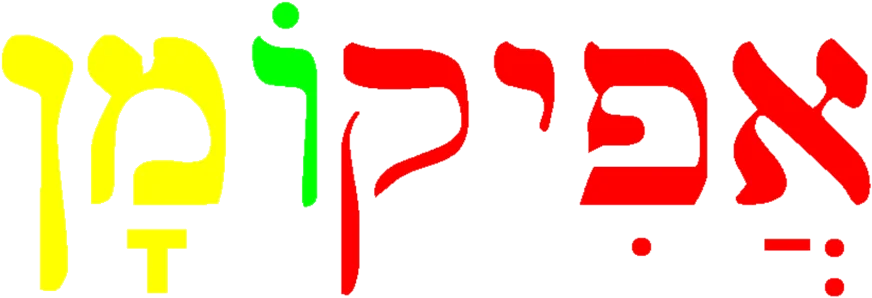
- The third part of the Passover makes present the act of making (cutting) a covenant between God and Israel, which was accomplished through the passage of the Lord and His people between the halves of the cut Rahab – Sea of Reeds – as people used to do in ancient times, making a covenant between themselves, and as the Lord Himself did once with Abram (cf. Gen 15:17-18; Jer 34:18-20). A form of liturgical realization of this particular act of making a covenant is to consume an unleavened Afikoman – אֲפִיקוֹמָן – as ‘manna (מָן) of going out and passing through the uncovered bottom (אֲפִיק) of the sea,’ and to recite thanksgiving prayers for food and a salvific exodus, and to ask for renewing of the going out with unleavened food. In the Book of Exodus the counterpart of the third part of the Passover is a pericope 13:17-14:31, presenting the Lord, who in signs of fire and cloud – the signs analogous to those under whose veil He made a covenant with their forefather Abram (cf. Gen. 15:17-18) – leads Israel out of Egypt and guides her between the waters of the divided Sea of Reeds.
- The fourth part of the Passover is a great thanksgiving for hearing the supplications, for the covenant made, giving freedom to Israel. The glorification of the Lord and power of His action is the thematic center of the words of recited prayers and the psalms of Hallel (Psa 115-118) and the Great Hallel (Psa 136), songs, hymns [1]. In the Book of Exodus, the equivalent of the fourth part of the Passover is the pericope 15:1-21, which shows the great hymn of Moses and men and Miriam and women. This hymn glorifies the Lord-Savior and shows His mighty power to fulfill the promises of the covenant that they have just made. The stanzas of the hymn, which they sang just after the miraculous crossing of the Sea of Reeds, show the Israelites being already in the Promised Land, even though historically they were still forty years away from entering it. This excellent hymn, followed by the pericope 15:22-18:27, serves both to glorify God and to strengthen the laws of the covenant in the memory of the people as the weaker contractor. Similarly, psalms, hymns and didactic songs of the Passover, and in some Jewish traditions also “Song of Songs,” write in the hearts of the Seder participants the law of gratitude to the Lord as the covenant contractor, and the law of loving Him as Bridegroom of Israel, His Spouse.
Celebrated by Israel each year, Passover preserves for centuries and millennia the structure hidden in the literary structure of the Book of Exodus 1-18. What is not visible while the reading focused on the course of the action presented colorfully by the biblical writer, becomes apparent while the reading focused on the discovery of the greatness of God, Lord Israel, and her Bridegroom [2].
The order (rite) – in Hebrew seder (סֵדֶר) – of the Passover feast is strictly defined at the level of structure [3]: it consists of four successive basic elements, corresponding to the successive four stages of making the Passover/exodus covenant.
Essential for this dissertation is the distinction (and simultaneously the connection) between the literary scheme of the covenant treaty and the scheme of the covenant-making ceremony: the treaty has six pericopes, of which the four middle ones report the course of four subsequent elements of the ceremony. To enter into a covenant with Israel, God did not perform the liberation process of Israel from Egypt by a single powerful strike on the Egyptians, quick taking out Israel from bondage, and then a quick leading of the Israelites along the Philistine road to Canaan (about four days [4] of the road) while defeating all those who would like to thwart Israel's going and entering the Promised Land and living in it. God performed it quite differently: He freed Israel in four successive stages, following the requirements of the ancient covenant-making ceremony.
One should emphasize: God Himself is the author of the Passover rite. He, after all, chose the language of human culture, the language of the ceremony of making ancient covenants, to speak to the chosen Nation when, successively entering the history, according to His plan, carried out the work of bringing Israel out of captivity in four main stages, preceded by a preparatory stage, crowned with a stage completing the whole of His plan.
The relation between the text Ex 1-18 and the actions of God is as follows: the text presents, in a culturally established treaty form of six pericopes, what God did really: (a) 1:1-6:1: before undertaking a covenant-making procedure; (b) 6:2-15:21: in four successive stages, i.e., in a manner culturally determined in antiquity, to make, as a sovereign, a covenant with Israel-vassal; (c) 15:22-18:27: after a covenant-making procedure.
Moreover, God accomplished the whole work of Israel’s deliverance in six successive stages. They began themself from that time when He was providing for the growth of Israel during the Egyptian oppression and then revealed Himself to Moses at the burning bush. They ended themself at the time when He ended leading His people from Egypt up the Mount Horeb, where Jethro and the Israelites participating in his sacrifice (cf. Ex 18) fulfilled the sign of worshipping God, which God foretold at the burning bush (cf. Ex 3:12). God carried out the whole work in six successive stages so that their faithful recording in the successive six pericopes matched exactly to then valid schemas of covenant treaties.
So it was God Himself who arranged the history of salvation according to the literary scheme of writing the treaties. Moses, on the other hand, wrote down faithfully what God did really for Israel and in the order He did.
One should emphasize that scientific research must not presuppose that the biblical text does not reliably convey the historical salvific facts in their correct order. Only then the exegete can assume that a literal interpretation of the text would be wrong when he uncontestedly discovers its literary genre as non-historical (for example, a fairy tale or Midrash). In the case of the text Ex 1-18, however, the literary genre is historical – it is an ancient covenant treaty.
Questioning the historical credibility of this biblical record would be contrary to both the teaching of the Church’s Magisterium [5] and reliable scientific solidity. Since the analyses precisely unveiled the literary genre of Ex 1-18, since it is a genre of ancient Hittite treaties, one can not call into question the historical value of this record. One must not call it in question, just as one must not call it in question the historical value of the Hittite treaties discovered by archaeologists – in common opinion, they are a record of historically credible political arrangements of ancient peoples, and not merely literary fiction, written for propaganda purposes. Ex 1-18 is an authentic treaty, with the same historical value as any other treaties. Ex 1-18 has the characteristics of treaties written no later than in the 12th century BC Ex 1-18 is, therefore, probably a treaty no younger than from the 12th century BC.
God speaks through words and deeds [6] – He always speaks according to the speech of those people to whom He addresses His words. God speaks through understandable Hebrew words to the Hebrews. God speaks through understandable cultural customs of men or by images that have culturally established interpretations.
It is worth noting:
- When God wanted to make a covenant with Abram (cf. Gen 15), He only told him to prepare animals – Abram knew what to do, without any other God’s explanation. God then adapted His acts to the culturally established covenant ceremony – He walked between the animals cut by Abram and uttered the words of the covenant.
- The same is true when God makes a covenant with Israel as a collective contractor: God speaks the language of the ancient covenants-making ceremony, a language that is certainly known to Moses as the adopted son of the Pharaoh’s daughter (cf. Ex 2) and thus undoubtedly a participant in Egypt’s political life [7].
Because the biblical writer arranged the text Ex 1-18 according to the requirements of the literary scheme of treaties from the 16th-12th centuries before Christ, so one can suppose it was Moses or someone writing under the direction of Moses (for example, Joshua – cf. Ex 17:14); or maybe Moses outlined the text, and Tradition passed it on with information about the principles of treaty writing [8].
It seems, however, that Moses himself could write the treaty – he was the best at it. The God Himself points it out in Ex 17:14: “Then the Lord said to Moses, ‘Write this down in a book as a memorial and recite it in the ears of Joshua, that I will utterly blot out the memory of Amalek from under heaven.’” [9] This record is indeed contained in Ex 1-18 as a treaty. So this part of the treaty is written by Moses. Moreover, if Moses wrote the part containing Ex 17:14, he could write the rest of the pericopes also, because they are, after all, more important than that one.
A more comprehensive solution to the issue of Ex 1-18 text dating would require a significant extension of the scope of research, which exceeds the framework assumed in this doctoral dissertation.
The research carried out allows us to answer an intriguing question posed by biblical scholars [10]. Namely: if one wrote the biblical books finally around the 6th century BC, and some of them or their fragments have a literary structure based on an ancient treaty scheme, why did this structure retain the scheme of treaties from the 12th century and not those from the 8th century? For it is known that the pattern certainly changed in the 8th century BC Namely, in the Aramaic and Assyrian texts of that period, it is so: after the introduction, there was a list of deities – witnesses of the treaty, then the requirements (law) of the treaty and blessings and curses, with the possibility of changing the order; there is no historical prologue here. In the schemas of the biblical books, however, there is a historical prologue.
In response, one should state: because Exodus took place around the 15th century BC [11] and because it followed the plan of God [12], who adapted the successive stages of the liberation process to the human pattern of making covenants from that period. Because Israel-vassal remembered that pattern, he could not change what God had inscribed both in the history of Exodus and in the covenant made under the layer of externally perceptible events of Exodus, and in the rite of the Passover, which makes present these two dimensions of one historical-salvific work of God.
One should always remember [13] that it was not hagiographers who arranged the salvific events according to the model of making a covenant (having some ‘own’ purpose in it – as many contemporary exegetes wrongly try to interpret, approaching the reading of the Bible with such a ‘pre-understanding’). It was God Himself who did it in the historical realities of the time of Exodus. It is only with this understanding that the historical value of the sacred text is preserved – it does not present any (arbitrary) human interpretations, but God’s knowledge about the truth of the events that He revealed, i.e., passed on through people.
In other words: hagiographers could not arbitrarily invent this literary scheme, referring to the habits of their own Middle Eastern culture – if God had not made a covenant between the waters of the Sea of Reeds, the covenant scheme could not have served as a literary model for the text Ex 1-18.
According to the common opinion of biblical scholars, biblical writer-editors gave final shape to the Holy Scriptures around the 6th century BC. Therefore, one must assume that biblical writers had great reverence to this holy pattern [14] of the covenant from the 16th-12th century BC because it was God’s and not only people’s way of describing the relations between the covenant partners. They owed their knowledge about this very scheme to the Holy Tradition of Israel. If it were not, after all, they would no longer have known in the 6th century BC the scheme from the 16th-12th century BC since another scheme, from the 8th century BC, was already widely used. Therefore, if the editors of Holy Scriptures, being under the inspiration of the Spirit of God, decided to arrange the literary heritage of the people of the Lord according to the scheme of treaties documenting a covenant-making, they did not apply the secular scheme from the 8th century BC, but this sacred pattern of the Exodus-covenant [15], which they knew from Holy Tradition. It is the Holy Tradition that carries the Revelation of God throughout the centuries.
This observation is a confirmation of the research results and valuable addition to them.
The conducted research allows solving many of the problems that contemporary biblical scholars face. The main one is worth mentioning:
M. Noth quite rightly claimed that since Ex 14 is the story about salvation in the sea, so one should consider it as the center of the Exodus theme/tradition [16]. At the same time, he could not discover connections between this story and the texts about the Passover – that is why he assigned these texts to a different tradition. The solution of the problem lies in understanding the text Ex 1-18 as the whole describing the making of the covenant of God and Israel between the divided waters of the sea. Then indeed, this “salvation in the sea” is the central moment of the rite, being the act of the covenant concluding/cutting, while the Passover legislative texts, being the law of this covenant, are the essential element preceding that crucial moment.
The conducted research also allows answering the question posed at the beginning of this dissertation: does the text Ex 1-18 divided according to the intention of the biblical writer unveil any special its features that one cannot see in other ways of dividing it?
The answer to this question is affirmative.
The existence of interesting numerical correlations has already been underlined several times during the analyses:
- in point 1.4.2.7.: the expression לַיהוָה – for the Lord – appears in the law pericope (Ex 12:1-13:16) 10 times, which is numerically equal to the number of the commandments given on Sinai; it is a discreet way of expressing the legislative character of this pericope,
- in point 1.4.2.3.: in the pericope 12:1-13:16 the number of occurrences of words relating to the time/date of feasting is 14 (7 times day + 4 times month + 3 times night), and thus numerically equals the date of the beginning of the feast (14th day of the month Abib, in the evening); this pericope is primarily to show the law of feasting in honor of the Lord who brought the Israelites out of bondage in the night of 14/15th day of the month Abib.
- in point 1.4.2.5: the term יצא, in Ex 12:39 specifying the moment of departure with unleavened dough, occurs 15 times in the pericope 12:1-13:16, so it numerically corresponds to the date of departure: the Israelites set off in 15th day of the month Abib.
- In point 1.4.2.5: in pericope 12:1-13:16, the word אכל (to eat) occurs 22 times, i.e., it is numerically equal to the date ending 7-days period of eating nonacidic foods (from the 14th day in the evening to the 21st day in the evening, i.e., when the 22nd begins). The biblical writer thus indicated how important it is to remember about not eating acid as the way to honor the Lord who brought them out of captivity so suddenly that they did not manage to prepare acidified dough for bread.
- In point 2.3.2.: God in Jer 7:22-23 characterizes with the word צוה (to command) one covenant which He made בְּיוֹם הוֹצִיאִי־אוֹתָם מֵאֶרֶץ־מִצְרַיִם (“on the day of My leading them out of the land of Egypt”). It is, therefore, the same covenant to which He contrasts the new covenant in Jer 31:32: in that covenant, God did not command any burnt offerings or sacrifices but commanded (צוה) obedience. It follows from this characteristic that this is not about the Sinai covenant, but about the Passover/Exodus covenant. The proof for this is the observation that in Ex 1-18 (being the covenant treaty!), the word צוה occurs precisely 15 times, i.e., it numerically corresponds to the date of the departure from Egypt, and thus to the date of making the Passover/Exodus covenant. In exactly 12 of these 15 places, God is the one who commands. This number corresponds to the number of 12 tribes of Israel – the recipient of God’s commands.
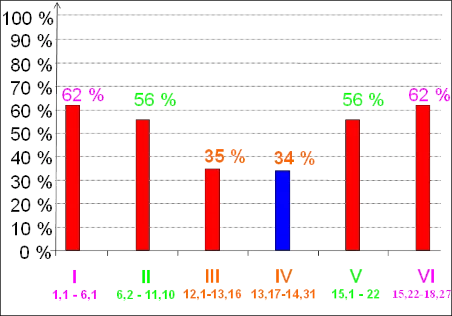
- In point 2.5.5.: in six successive pericopes, the frequency of the forms of past tense to the forms of the future tense is as follows: 62%, 56%, 35%, (100-34)%, 56%, 62%. Thanks to it, the arrangement of six pericopes is a concentric structure A B C C’ B’ A’; it is even chiasmus due to the relation between the middle pericopes: 35% ≈ (100-34)%.
- In point 3.2.: From all over Israel’s history, the biblical writers chose and described in the Scriptures just only six Passover celebrations (1. Ex 1-18; 2. Numbers 9:1-5; 3. Josh 5:10n; 4. 2Chr 30, 1-27; 5. 2Kings 23:21-23 and 2Chr 35, 1-19; 6. Ezra 6:19-22). The number of these chosen events – 6 – is equal to the number of pericopes of the text Ex 1-18; they constitute the six-element structure of the treaty describing the conclusion of the Passover/Exodus covenant.
- In points 3.3.1. and 3.4.4., and 3.5.2.: the numerical identity of four parts of the Passover rite and four elements of the literary structure of the law pericope 12:1-13:16 (a biblical pattern for the Passover Seder). The Hebrew phrase “with a mighty hand the Lord brought you out from Egypt” appears four times in the fourth element of this structure (13:1-16).
- In point 3.3.8: as The Halacha prescribes that the third cup should contain 1/4 wine and 3/4 water, so the description of the Israelites’ departure (Ex 12:27b-42. 50-51) occupies 1/4 of the text of the law pericope (Ex 12:1-13:16), and 3/4 is for legislative formulas. In this way, one linked the departure of Israelites from Egypt with the third cup.
To the already given correlations it is now worth adding the number of occurrences of the sequence: לַיהוָה – for the Lord – in the successive pericopes:
| I | Ex 1:1-6:1 | 3 times | |
|---|---|---|---|
| II | Ex 6:2-11:10 | 9 times | Ex 6:2-15:21: 22 times |
| III | Ex 12:1-13:16 | 10 times | |
| IV | Ex 13:17-14:31 | 0 times | |
| V | Ex 15:1-21 | 3 times | |
| VI | Ex 15:22-18:27 | 3 times |
One can see that the outer pericopes I and VI are the literary inclusion for the entire Ex 1-18 text, both because they contain the same number of occurrences of the לַיהוָה sequence (3 times) and because the Ex 6:2-15:21 text they embrace contains this sequence 22 times, and this number corresponds to the date (22. Abib) of the end of the period of eating only the unleavened food for the honor of the Lord. One must recall (see 1.4.2.7. – click here, please!) that as many times, that is 22, there is the word eat (אכל) in the law pericope (Ex 12:1-13:16).
It is now worth seeing how the number of occurrences of the word אכל (eat) distributes itself:
| I | Ex 1:1-6:1 | 2 times | Ex 1:1-18:27: 40 times |
|---|---|---|---|
| II | Ex 6:2-11:10 | 4 times | |
| III | Ex 12:1-13:16 | 22 times | |
| IV | Ex 13:17-14:31 | 0 times | |
| V | Ex 15:1-21 | 1 time | |
| VI | Ex 15:22-18:27 | 11 times |
Thus, only two numbers are characteristic: the word אכל appears 22 times in the law pericope, and simultaneously 40 times in the whole text Ex 1-18, which corresponds to the number of years of God’s people’s way to the Promised Land. It confirms that it is according to the biblical writer’s intention, that the text Ex 1-18 is a literary and theological whole, and, within this whole, Ex 12:1-13:16 is a coherent pericope.
The above-listed dependencies testify to the well-thought-out structure of the text Ex 1-18. They complement and confirm what one discovered in point 2.5.5. of the present dissertation by examining the frequency of the forms of the past tense and the forms of the future tense in particular pericopes: the arrangement of six pericopes is the chiasmus A B C C’ B’ A’.
Similarly, the accuracy and mastery of the arrangement of the six pericopes of the text Ex 1-18 unveil itself to the reader thanks to the alternating change in the literary genre of subsequent pericopes – elements of the structure, which one discovered in the first chapter of the dissertation. With the help of this criterion, however, one cannot separate the pericope 1:1-6:1 from 6:2-11:10. Probably it was the reason why the Masoretes, who added vowel signs to the text, here, in addition to them, put a particularly clear sign of closing/beginning of pericope [17] between verses 6:1 and 6:2 in the Hebrew text, transmitted by Jewish Tradition.
The Ex 1-18 structure shown here is a masterpiece of Hebrew rhetoric. It is similar in this respect to the structure of the Letter to the Hebrews, discovered by A. Vanhoye [18], in which there is also an alternating change in the literary genre of the successive pericopes, except that the three middle pericopes are not subject to this principle. It is, however, not a lack, but an exquisite technique, by which the biblical writer has indicated that they are the center of symmetry for the remaining pericopes-elements [19].
The literary composition of the Book of Exodus 1-18 astonishes and delights with its beauty. God apparently decided the Passover – the celebration making present His covenant of love with Israel – to be dressed in the robe of a literary masterpiece.
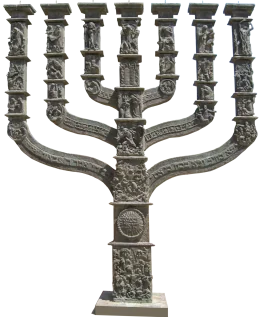
This God’s literary masterpiece seems to be God’s model (cf. Ex 26:30; cf. also 1Chr 28:19) according to which Moses was to make a lampstand (cf. Ex 25:31-36) for the tabernacle. According to many exegetes [20], such a model is in the burning bush, which is a place chosen by God (cf. Ex 3:1-6) to initiate the process of Israel’s liberation and, at the same time, to make a covenant of Passover/Exodus with her.
Here are six arms arranged symmetrically around the middle shaft of the lampstand (cf. Ex 25:32), three on each side, with the arms closest to the base being the longest and the arms closest to the apex being the shortest [21]; their lengths, therefore, maintain the same relation as the mentioned above frequencies of forms of past and future tense in the pericopes, counting from the outer to the inner pericope (62% > 56% > 35%).
Probably more than one astonishment awaits the readers of this God’s Book. After all, one should still expect from God the grace of more fully understanding of His Holy Word. One is to hope that the day is near when we will fully understand and love more than we do today, and among the signs of His love we will read according to His plan also what He has announced through the Prophet Jeremiah in the translation of the Greek Septuagint [22], and what many understand as the announcement of the miracle of a New Exodus on the very day of the Passover Feast:
ἰδοὺ ἐγὼ ἄγω αὐτοὺς ἀπὸ βορρᾶ καὶ συνάξω αὐτοὺς ἀπ᾽ ἐσχάτου τῆς γῆς ἐν ἑορτῇ φασεκ καὶ τεκνοποιήσῃ ὄχλον πολύν καὶ ἀποστρέψουσιν ὧδε.
At this point, one should finish an in-depth reading of the original First Covenant Passover rite. One should expect a full understanding of it in the New and Eternal Covenant, announced by the Prophet Jeremiah (31:31f), a covenant no longer made in the waters of the Sea of Reeds, but in the Red Sea of the Blood of Jesus-Messiah [23], expected by Israel each year during the celebration of the Passover.
Appendix.
One illustrated the rhetorical and numerical characteristics mentioned in the doctoral dissertation in the following charts and pictures.
In six successive pericopes, the frequency of the forms of past tense to the forms of the future tense is as follows: 62%, 56%, 35%, (100-34 )%, 56%, 62%. Thanks to it, the arrangement of six pericopes is a concentric structure A B C C’ B’ A’:
 |
| These proportions are similar to that of the Menorah branches: |
|
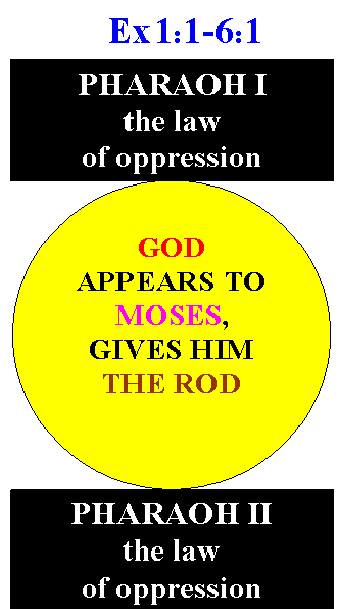
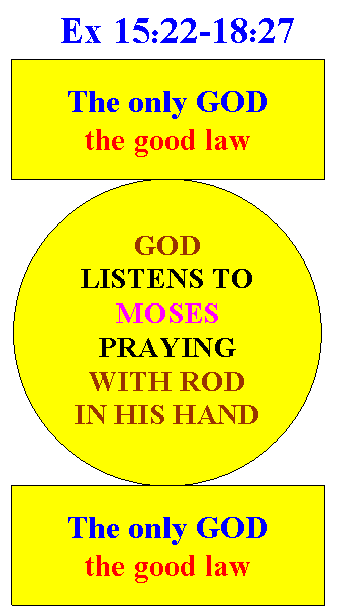
Outer pericopes, which are the literary inclusion for the main four pericopes, have the same three-element structure:
 |  |
Afikoman – it is not a Greek but Hebrew Word:
Cf. Pope Pius XII, Encyclical Divino Afflante Spiritu, No. 1-3. Cf. on the Internet – click here, please! Cf. Vatican Council II, Dogmatic Constitution on Divine Revelation (Dei Verbum), No. 11 b.
[19] Cf. T. Jelonek, List do Hebrajczyków [Letter to the Hebrews], Kraków 2005, pp. 71-72: in a legible table, the author presents 14 elements of the structure. One did not specify the literary genre for the first (prologue) and the last (conclusion) element. One arranged the other elements as follows:
e – l – e – l –– e – e – e –– l – e – l – e
A B A’,
where l – a doctrinal lecture; e – an encouragement.