TO THE MAIN
PRESENTATIONS PAGE
CLICK TO GO UP
index.html
The Original Rite of the Passover
in the Light of the Literary Scheme
of the Book of Exodus 1–18
The Internet presentation of the main Questions
dr Wojciech Kosek
This study in Polish was published here
in The Day of the Lord’s Passover,
Good Friday, 10 April 2009.
The translation to English was made by the author
and was published here in
the Solemnity of the Immaculate Conception of the Blessed Virgin Mary,
8. December 2010.
This merged publication was prepared and published here on 23 April 2026, on the Memorial of Saint Adalbert (Saint Wojciech).

to familiarize yourself with this online presentation of the basic questions leading to understand both the contemporary biblical exegesis (the scientific explanation of the Holy Bible) as well as the basic scheme on which the rite of the Jewish Passover was built.
Passing to each elaboration constituting this merged presentation is made through the links below in the table of contents. After reading a chosen elaboration, you can return to its proper place in the table of contents by clicking on the link "Contents".
Please take into account this significant information: in the presentation in several important places there are shown explanations of Hebrew words, written in a special font which must be installed by you on your computer. For more information about this topic – click: The installation of the Hebrew and Greek fonts.
THE TABLE OF CONTENTS:
- The introduction:
- Rules of reading and scientific deepening of the Bible:
- Rules of Hebrew rhetoric (the composition of the texts) and Formgeschichte:
- The Hebrew Bible:
- Difficulties in interpreting the Book of Exodus:
- Introduction: the Magisterium’s teaching about difficulties in the interpretation
- Exo 3–4 and Exo 6,2–8: two descriptions or two events?
Exo 4,24–26: did the Lord want to kill Moses? - The genealogy of Moses and Aaron (Exo 6,14–26): what is the aim of it?
- Plagues / wonderful signs: where are the boundaries of the description?
- Passover: where are the boundaries of the description?
- The march out of Egypt: where is the beginning of the description?
- How read the Bible to read out the content written by the Author?
- The theocentric analysis of Exodus according to the rules of the Hebrew Rhetoric:
- The recollection of the question of the main character and literary structure
- The initial presentation of findings
- The literary structure of the two external pericopes 1,1–6,1 and 15,22–18,27
- Pericopes 1,1–6,1 and 5,22–18,27 as the rhetorical inclusion for Exo 1–18
- The Summary of the Analysis of the Book of Exodus 1,1–6,1 and 15,22–18,27
- The literary structure of the whole Exo 1–18:
- Exo 1–18 and covenant treaties of peoples of the ancient East
- The Jewish Passover and the structure of its rite
- The rite of the Passover in the light of “The Passover Haggadah”: Introduction
- The rite of the Passover according to “Haggadah”: the main problem statement
- The division of the Passover ritual into four main sections (four cups)
- The part 3. of the Passover: afikoman as manna of the covenant making
- The part 3. of the Passover: biblical texts: Exo 12,34–39; 13,21; 14,19–22.24
- The part 3. of the Passover: biblical texts: the covenant making in Genesis 15,1–20
- The Passover ritual and the God’s covenant with Israel
- The Passover ritual in the light of the Hittite covenant ceremony
- The Passover ritual as the “making present” of the 4–part covenant ceremony performed in four stages of the exodus from Egypt
- The structure of the Book of Exodus 1–18 and the structure of the six–branched lampstand in the Holy Tabernacle (Exo 25,31–40)
Exod02.html
THE MAIN CHARACTER AND THE LITERARY STRUCTURE
OF THE BOOK OF EXODUS
presentation of the problem
The fragment of the book of Exodus shown below was taken from the international edition of the Bible [1], and it includes:
- translations of the sentences of the Hebrew text,
- headings rendered in a bold font and being of a greater size or in italic,
- indents of text,
where headings and text indents divide the text into smaller literary units. It is necessary to know that they are not in the Hebrew text, but were added by the International contemporary editors who worked on the translation for many years.
Exodus |
The Israelites Oppressed |
1 These are the names of the sons of Israel who went to Egypt with Jacob, each with his family: 2Reuben, Simeon,Levi and Judah; 3Issachar, Zebulun and Benjamin; 4Dan and Naphtali; Gad and Asher. 5The descendants of Jacob numbered seventya in all; Joseph was already in Egypt. 6Now Joseph and all his brothers and all that generation died, 7but the Israelites were fruitful and multiplied greatly and became exceedingly numerous, so that the land was filled with them. 8Then a new king, who did not know about Joseph, came to power in Egypt. 9“Look,” he said to his people, “the Israelites have become much too numerous for us. 10Come, we must deal shrewdly with them or they will become even more |
The Birth of Moses |
2 Now a man of the house of Levi married a Levite woman, 2and she became pregnant and gave birth to a son. When she saw that he was a fine child, she hid him for three months. 3But when she could hide him no longer, she got a papyrus basket for him and coated it with tar and pitch. Then she placed the child in it and put it among the reeds along the bank of the Nile. 4His sister stood at a distance to see what would happen to him. 5Then Pharaoh’s daughter went down to the Nile to bathe, and her attendants were walking along the river bank. She saw the basket among the reeds and sent her slave girl to get it. 6She opened it and saw the baby. He was crying, and she felt sorry for him. “This is one of the Hebrew babies,” she said. |
a5 Masoretic Text (see also Gen. 46:27); Dead Sea Scrolls and Septuagint (see also Acts 7:14 and note at Gen. 46:27) seventy–five b22 Masoretic Text; Samaritan Pentateuch, Septuagint and Targums born to the Hebrews |
On this page there are visible headings („Exodus”, „The Israelites Oppressed”, „The Birth of Moses”) and indents of text (at the beginning of verses: in the first chapter: 6, 8, 11, 15, 19, 20, 22; in the second chapter: 5).
These headings and indents are to help the reader to quickly know the main problems of the text contained between them. One ought to notice that they simultaneously:
- give the literary structure for the text, i.e. divide it thematically into “main parts”, “sections”, “subsections”;
- indicate who is the main character of each part.
Every reader should know, however, that contemporary editors are not always able to perform the task set for by themselves to accurately express the idea of the hagiographer / editor working under the inspiration of the Holy Spirit, editor of the final text of the book, written in Hebrew ages ago (it is supposed that the final editing occurred about the sixth century before Christ – when Israel was in captivity in Babylon.)
It is necessary yet to notice that in quite a few cases the many years of exegetic research of the Hebrew text is needed to find: 1. what literary structure for the text gave the last editor–hagiographer working under the God’s inspiration, and 2. who is the main character in his counsel.
Having observed particular headings from the international edition of the Bible one can notice that – according to the contemporary international editorial staff – it is Israel and her leader, Moses, who are together the main character of the Book of Exodus.
Does the answer for the question of the main character, being read from headings, correspond to the intention of the Hebrew hagiographer–editor of the final version of the inspired text? – it is the key–question for the analysis which will be conducted here. Equally important is the second question: Does the literary structure of the Book of Exodus 1–18, being read from headings and indents, is a structure given to the Book by this inspired hagiographer–editor?
Exod03.html
THE DIVISION OF THE BOOK OF EXODUS 1–18
examples of different English and other language editions of the Bible
Below there are presented manners of dividing the Book of Exodus in different foreign–language editions. This specification shows how different editorial staffs, translating the Book of Exodus, understood its literary structure.
The example of the Bible in English: The Jerusalem Bible [1]:
| Part I | 1,1–15,21 | THE LIBERATION FROM EGYPT |
|---|---|---|
| A | 1,1–12,36 | ISRAEL IN EGYPT |
| B | 2,1–7,7 | EARLY LIFE AND CALL OF MOSES |
| 2,1–10 | The birth of Moses | |
| 2,11–22 | Moses escapes to Midian | |
| 2,23–7,7 | The Call of Moses | |
| C | 7,8–13,16 | THE PLAGUES OF EGYPT – THE PASSOVER |
| D | 13,17–15,21 | THE CROSSING OF THE SEA OF REEDS |
| Part II | 15,22–18,27 | ISRAEL IN THE DESERT |
| Part III | 19,1–24 | THE COVENANT AT SINAI |
| Part IV | 25,1–31,18 | INSTRUCTIONS ON THE BUILDING OF THE SANCTUARY AND ON ITS MINISTERS |
| Part V | 32,1–34,35 | ISRAEL’S APOSTASY. THE COVENANT RENEWED |
| Part VI | 35,1–40,38 | THE FURNISHING AND BUILDING OF THE SANCTUARY |
The example of the Bible in German: Die Heilige Schrift des Alten Bundes [2].
| Part I | 1,1–15,21 | Die Befreiung aus Ägypten |
|---|---|---|
| 1,1–22 | 1. Israel in Ägypten [3] | |
| 2,1–7,7 | 2. Jugend und Berufung des Mose [4] | |
| 7,8–13,16 | 3. Die Ägyptischen Plagen. Das Pascha [5] | |
| 13,17–15,21 | 4. Der Durchzug durch das Schilfmeer [6] | |
| Part II | 15,22–18,27 | Die Wüstenwanderung [7] |
| Part III | 19,1–40,38 | Der Bund am Sinai [8] |
The second example of the Bible in German: Das Alte Testament [9]:
| Part I | 1,1–11,10 | ISRAEL IN ÄGYPTEN [10] |
|---|---|---|
| Part II | 12,1–18,27 | DER AUSZUG AUS ÄGYPTEN [11] |
| Part III | 19,1–40,38 | AM SINAI |
The example of the Bible in French: La Bible. Traduction œcuménique de la Bible [12]:
| Part III | 1,1–15,21 | DIEU FAIT SORTIR ISRAËL DU PAYS D’ ÉGYPTE [13] |
|---|---|---|
| 15,22–18,27 | LA MARCHE DES ISRAÉLITES DANS LE DÉSERT [14] | |
| 19,1–24,18 | DIEU FAIT ALLIANCE AVEC ISRAËL | |
| 25,1–31,18 | LE PLAN DU SANCTUAIRE | |
| 32,1–34,35 | LE VEAU D’OR | |
| 35,1–40,38 | LA CONSTRUCTION DU SANCTUAIRE |
Exod04.html
THE DIVISION OF THE BOOK OF EXODUS 1–18
examples of different Polish editions of the Bible
Below there are presented manners of dividing the Book of Exodus in different Polish editions. This specification shows how different editorial staffs, translating the Book of Exodus, understood its literary structure.
The division of Book of Exodus in Biblia Wujka (i.e. The Jakub Wujek Bible) [1] in the elaboration of S. Styś [2]:
| Part I | 1,1–18,27 | Z EGIPTU DO SYNAJU |
|---|---|---|
| I | 1,1–12,36 | Aż do wyjścia z Egiptu |
| 1,1–22 | Izraelici w Egipcie [3] | |
| 2,1–7,13 | Mojżesz i jego posłannictwo… [4] | |
| 7,14–12,36 | Plagi egipskie [5] | |
| II | 12,37–15,21 | Wyjście z Egiptu [6] |
| III | 15,22–18,27 | Od Morza Czerwonego do Synaju [7] |
| Part II | 19,1–40,38 | NA SYNAJU. PIERWSZE PRAWODAWSTWO |
The division of Book of Exodus in Biblia Wujka (i.e. The Jakub Wujek Bible) in the elaboration of J. Frankowski [8]:
| Part I | 1,1–18,27 | WYBAWIENIE Z NIEWOLI EGIPSKIEJ |
|---|---|---|
| 1,1–2,22 | particular subparts see in the footnote [9] | |
| 2,23–25 | Bóg wspomina na przymierze z Abrahamem | |
| 3,1–4,31 | Objawienie się Boga Mojżeszowi [10] | |
| 5,1–6,1 | Pierwsze spotkanie Mojżesza z faraonem Pogorszenie się sytuacji Izraelitów | |
| 6,2–13 | Drugi opis objawienia się Boga, powołania Mojżesza | |
| 6,14–30..7,13 | particular subparts see in the footnote [11] | |
| 7,14–10,29 | Plagi egipskie | |
| 11,1–10 | Zapowiedź ostatniej plagi | |
| 12,1–20 | Noc paschalna. Baranek i przaśniki | |
| 12,21–30 | Śmierć pierworodnych | |
| 12,31–51 | Wyjście | |
| 13,1–10 | Przepisy dotyczące święcenia Paschy w Ziemi Obiecanej | |
| 13,11–16 | Prawo o pierworodnych | |
| 13,17–22 | Droga Izraela po wyjściu z Egiptu | |
| 14,1–31 | Pogoń; przejście przez Morze Czerwone | |
| 15,1–21 | Pieśń wybawionych… | |
| 15,22–18,27 | U wód Mara… [12] | |
| Part II | 19,1–40,38 | NA SYNAJU. PRZYMIERZE I PRAWO |
The Book of Exodus in the elaboration of S. Łach [13] of 1964 year:
| Part I | 1,1–13,16 | IZRAEL W EGIPCIE |
|---|---|---|
| 1,1–7,13 | particular subparts see in the footnote [14] | |
| 7,14–10,29 | Plagi egipskie | |
| 11,1–13,16 | Noc paschalna i wyjście z Egiptu | |
| Part II | 13,17–18,27 | PODRÓŻ Z EGIPTU POD SYNAJ |
| Part III | 19,1–31,18 | ZAWARCIE PRZYMIERZA NA SYNAJU |
| Part IV | 32,1–40,38 | APOSTAZJA IZRAELA I ODNOWIENIE PRZYMIERZA |
The Book of Exodus in the elaboration of S. Łach [15] of 1996 year:
| Part I | 1,1–18,27 | UWOLNIENIE IZRAELITÓW Z EGIPTU |
|---|---|---|
| I | 1,1–15,21 | Izrael w Egipcie |
| 1,1–7,13 | particular subparts see in the footnote [16] | |
| 7,14–10,29 | Plagi egipskie | |
| 11,1–13,16 | Noc paschalna i wyjście z Egiptu | |
| 13,17–14,31 | Cudowne przejście przez morze | |
| 15,1–22 | Pieśń dziękczynna | |
| II | 15,22–18,27 | Droga z Egiptu pod Synaj |
| Part II | 19,1–40,38 | ZAWARCIE PRZYMIERZA NA SYNAJU. PIERWSZE PRAWA |
The Book of Exodus in Biblia Poznańska [17]:
| 1,1–7,13 | SECTION without the editor’s title | |
|---|---|---|
| 1,1–22 | Ucisk Izraelitów w Egipcie | |
| 2,1–15 | Młodość Mojżesza | |
| 2,16–22 | Mojżesz u Midianitów | |
| 2,23–3,22 | Powołanie Mojżesza | |
| 4,1–17 | Przygotowanie Mojżesza do misji | |
| 4,18–31 | Mojżesz wraca do Egiptu | |
| 5,1–6,1 | Pierwsze spotkanie z faraonem | |
| 6,2–13 | Relacja [18] o objawieniu Imienia Jahwe, paralelna do tej z Wj 3–4 | |
| 6,14–27 | Genealogia Mojżesza i Aarona | |
| 6,28–7,13 | Aaron tłumaczem Mojżesza | |
| 7,14–11,10 | PLAGI EGIPSKIE | |
| 12,1–36 | PASCHA | |
| 12,1–14 | Pierwsze polecenia | |
| 12,15–20 | Święto Przaśników | |
| 12,21–36 | Śmierć pierworodnych | |
| 12,37–15,21 | WYJŚCIE Z EGIPTU | |
| 12,37–42 | This subpart hasn’t title | |
| 12,43–51 | Udział obcych w Święcie Paschy | |
| 13,1–2 | Nakaz poświęcenia Bogu pierworodnych [19] | |
| 13,3–16 | Pouczenia rytualne | |
| 13,17–31 | Przejście przez morze | |
| 15,1–21 | Pieśń wdzięczności | |
| 15,22–18,27 | POCHÓD OD MORZA KU GÓROM SYNAJU | |
| 19,1–40,38 | ZAWARCIE PRZYMIERZA Z BOGIEM …[20] |
This Bible is nowadays in two editions: 1. of S. Styś and 2. of J. Frankowski. About this and the other Polish translations of the Bible, see: M. Wojciechowski, O biblistyce w Polsce, [in:] W. Chrostowski and others (red.), „Zeszyty Naukowe Stowarzyszenia Biblistów Polskich” 4 (2007), 253–254.
Exod05.html
TRUTHFULLY SCIENTIFIC
METHODOLOGICAL RULES
OF THE BIBLE RESEARCH
- Books of the Bible are not the compilations, i.e. they are not the unordered collections of earlier texts, as it was assumed by Formgeschichte (see H. Gunkel)
- Books of the Bible are the compositions, i.e. the logical structures of elements–pericopes, structures given by the last editor of each book (R. Meynet – French biblical scholar):
- Biblical texts were composed and well composed.
- There is a specifically Hebrew rhetoric, i.e. the complex of Hebrew ways of thinking and composing of literary works, which are different to the classical Greek rhetoric.
- One ought to rely primarily to the text, and very carefully take into account the corrections drifted on the text by the representatives of the historical–critical method.
Note:
These problems are discussed for example here:
Exod06.html
WHETHER THE INVESTIGATION
OF THE ELEPHANT
THROUGH THE LOUPE
IS A GOOD METHOD?
Let us notice:
- If I always look through the loupe on the skin of the elephant, then:
- I will never see the elephant en bloc,
- I will never know that elephants exist.
The Formgeschichte method presupposes that the text of the Bible must be broken into smaller units of the definite class of literature, but does not assume that the each book in its canonical form (i.e. the form given for each book by its last hagiographer–editor, inspired by God), has the literary structure being superior over these units and ordering the manner of the interpretation of these units.
Exod07.html
THE HISTORICAL TRUTH OF EXO 1–18:
a fundamental methodological criterion
Let us name the two following types of literary genres as “historical genres”:
- The historical report,
- The historical novel (i.e., either a fiction/tale imitating historical relation or an intentionally written mendacious history).
Let us note:
- If somebody writes mendacious history, he does not use any characteristic, specific literary genre, the genre being used exclusively for mendacious histories. Quite the opposite – anyone interested in lying to his readers makes everything so that his “work” could be considered a true story. To achieve the deception goal, such a “creator” applies the same literary genre as the authors of the true histories do.
- After considering the features of the author of the text, one ought to pass to consider the features of the text itself. It should be ascertained: the text of mendacious history does not differ structurally by the literary form (literary genre) from the true history.
- After considering the author’s features and text features, one ought to think over the reader’s possibilities and impossibilities. It should be noted:
- The reader or explorer using the linguistic criterion itself will never be able to distinguish the historical relation (i.e., true history) from the historical novel (i.e., imaginary story) because the same grammatical/terminological dress appears in these both historical genres of literature.
- Therefore, in researching the Bible, one cannot presuppose that the text written in compliance with a convention of the historical literature genre is not a historical relation but only a novel (historical fiction). Many representatives of scientific circles succumb to this methodological error (including Biblicist that use the Redaktionsgeschichte method, although they appreciate the text in its final form).
It is worth recalling what Pope Benedict XV wrote in 1920, in the Encyclical Spiritus Paraclitus [1]: “history (…) must square with the facts, since history is the written account of events as they actually occurred” (No. 22).
Then the Pope notes that the Bible does not contain “pseudo-historical narratives” or “such kinds of literature [which] cannot be reconciled with the entire and perfect truth of God’s word” (No. 26)
Exod08.html
THE HISTORICAL TRUTH OF EXO 1–18:
in the light of the rule of obedience to the Magisterium of the Church
If it is found as a result of research that Exo 1–18 meets the requirements being placed on the historical classes of literature then:
- Nobody can state in advance that it is only the hagiographer’s literary form of expressing the intervention of God in the interest of Israel
(as it is usually understood by the Biblical scholars working under the assumptions of the Formgeschichte method) - One ought to understand – in the obedience to the Magisterium of the Church – the Book of Exodus 1–18 is a historic document, the true one, not being thought-out by the writer for some aims important for him.
This should be done and it is worth to be done: knowing the truth about God’s revelation and of the meaning of God’s speech addressed to the man will be an excellent result of this attitude, since Jesus Christ said to the Apostles and their successors (Luk 10,16):
NAB “Whoever listens to you listens to me. Whoever rejects you rejects me. And whoever rejects me rejects the one who sent me”.
Exod09.html
IT IS WORTH TO KNOW RULES OF HEBREW RHETORIC
(semitic techniques of literary composition):
- Precursors are: R. Lowth and J. Bengl (XVII century)
- Relationships between elements of the structure:
- parallelisms: Cf. Catholic Encyclopedia;
See also: J. R. Lundbom
- synonymous
- antithetical
- synthetic
- concentric structures A B C B’ A’
- chiasmus structures A B C C’ B’ A’ – Cf. Wikipedia
- inclusions A …………….. A
- parallelisms: Cf. Catholic Encyclopedia;
See also: J. R. Lundbom
- These relations can connect:
- not only verses,
- but also greater fragments of the text.
- The literary medium of the meaning are (A. Schökel, 1981):
- not only words or sentences,
- but also relations between elements of the work structure.
- The study of the literary structure is like a radiography of the text (S. Hałas, 1998).
Examples of the Hebrew Rhetoric:
- Parallelisms:
- Gen 27:29: the series of three successive parallelisms: two first are synonymous, and the third is antithetical:
- Let peoples serve you, And nations bow to you;
- master over your brothers, And let your mother’s sons bow to you.
- Cursed be they who curse you, Blessed they who bless you.
- Sir 24:20–22: the series of three successive parallelisms: the first is synonymous, two next are synthetic:
- 20 For the memory of me is sweeter than honey, and the possession of me sweeter than the honeycomb.
- 21 Those who eat of me will hunger for more, and those who drink of me will thirst for more.
- 22 Whoever obeys me will not be put to shame, and those who work with me will not sin.
- Isa 51,9–10: – please click to read the discussion of this parallelism in my doctoral dissertation; (You should select pages 209–217 there)!
- Gen 27:29: the series of three successive parallelisms: two first are synonymous, and the third is antithetical:
- Inclusion:
- chiasmus: Chiasmus: chiasmus consisting of six pericopes
Exod10.html
THE EXPLANATION OF THE CONVICTION OF REPRESENTATIVES
OF THE FORMGESCHICHTE METHOD:
The Bible is only a valuable collection of various, mainly damaged, fragments of an ancient history:
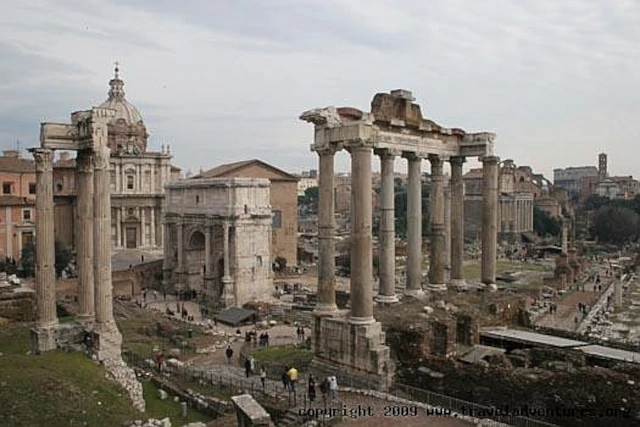
The photo is placed here with the consent of the owner of the website http://traveladventures.org
Exod11.html
THE EXPLANATION OF THE CONVICTION OF REPRESENTATIVES
OF METHODS OPPOSITE TO THE FORMGESCHICHTE
(Childs, Meynet):
Books of the Bible are beautiful,
precisely composed;
it is necessary to discover their hidden beauty,
recorded by means of language from before 3000–2000 years.
The below photo of the temple does not show it en bloc, so we do not know whether it is well kept (or else it has damages – as it was on the photo in the Previous screen). A question about the degree of damage of the temple can be resolved not by guesswork, but by the humble search for the truth. When somebody ask for the degree of damages of the Bible text, he ought to act similarly. It is illustrated in the next screen.
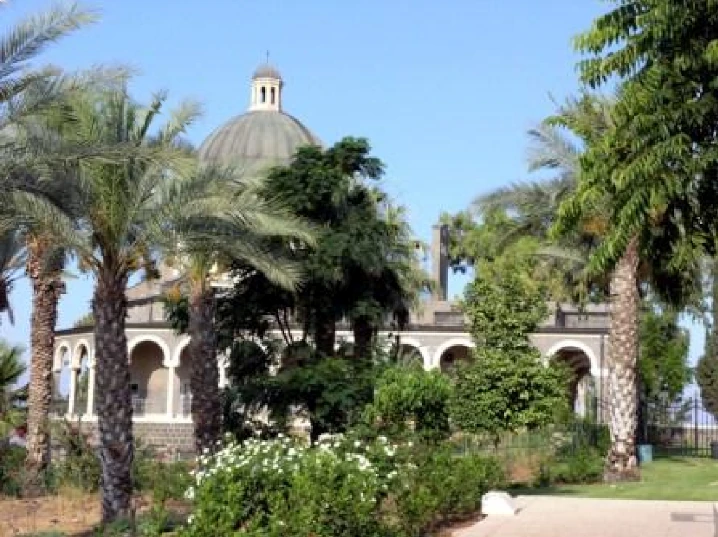
The photo is placed here with the consent of the author,
reverend professor dr hab. Tomasz Jelonek,
professor of the Pontificial University of John Paul II in Cracow
Exod12.html
THE EXPLANATION OF THE CONVICTION OF REPRESENTATIVES
OF METHODS OPPOSITE TO THE FORMGESCHICHTE
(Childs, Meynet):
Books of the Bible are beautiful,
precisely composed;
it is necessary to discover their hidden beauty,
recorded by means of language from before 3000–2000 years.
The below photo of the temple shows it en bloc. Now we know that there are no damages here (how it was in penultimate screen), that it is beautifully composed by the architect. Similarly, in the studies of the Bible in consequence of the humble research of the truth, one can discover the beauty, the harmony, the composition of the book or its parts – it is possible to discover what is not available by a hasty reading …
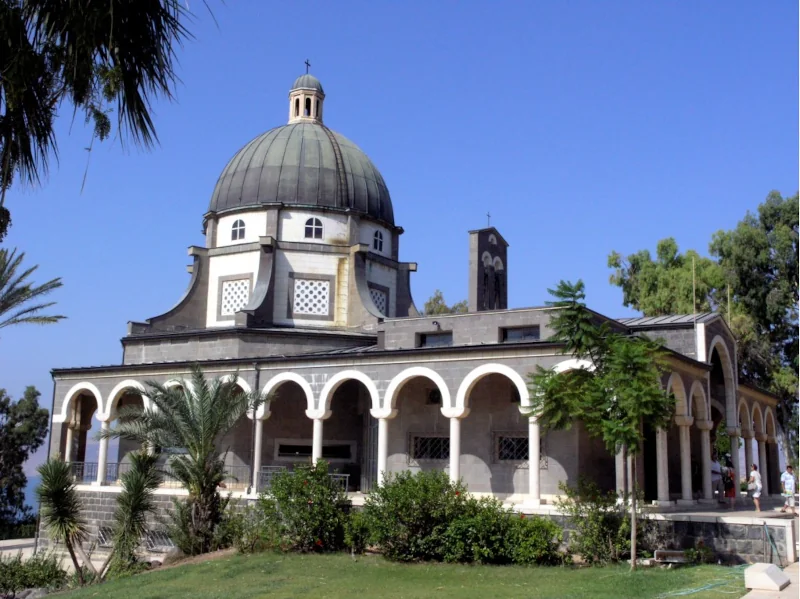
The photo is placed here with the consent of the author,
reverend professor dr hab. Tomasz Jelonek,
professor of the Pontificial University of John Paul II in Cracow
Exod13.html
THE HEBREW BIBLE
AS THE SOURCE OF THE DIVINE REVELATION
The presented below example text of the Book of Exodus 4,18–23 from the Hebrew Bible shows the manner of recording of the God’s Revelation, the manner used by the inspired writers about six centures before the birth of Christ. In the text there are also visible Arabic numerals and Latin letters, introduced by contemporary publisher.
It is worth noting that this Hebrew text is a basic source for exegetical studies, whose aim is the most faithful reading of the divine revelation. The importance of this task cannot be overestimated because translator–exegete has to transmit the words of God himself!
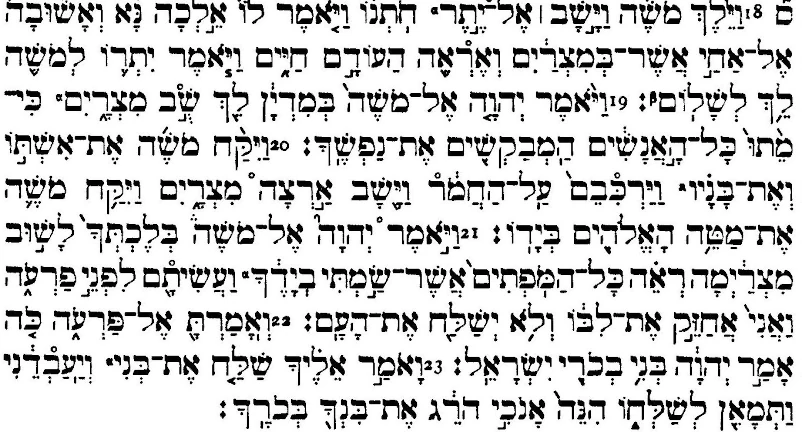
Is it necessary today to read a Hebrew text since we have good, widely accepted translations of the Bible in the native languages?
Exod14.html
THE HEBREW BIBLE
AS THE SOURCE FOR THE RESPONSIBLE INTERPRETATION
OF THE DIVINE REVELATION
Is it necessary today to read a Hebrew text since we have good, widely accepted translations of the Bible in the native languages? The answer is given by the Pope Pius XII in the Encyclical Divino afflante Spiritu [1]:
“15. (…) For it is the duty of the exegete to lay hold, so to speak, with the greatest care and reverence of the very least expressions which, under the inspiration of the Divine Spirit, have flowed from the pen of the sacred writer, so as to arrive at a deeper and fuller knowledge of his meaning. 16. Wherefore let him diligently apply himself so as to acquire daily a greater facility in biblical as well as in other oriental languages and to support his interpretation by the aids which all branches of philology supply.”.
And next about the Bible texts:
“the original text (…) having been written by the inspired author himself, has more authority and greater weight than any even the very best translation, whether ancient or modern”.
Dear Reader!
With the awareness of the importance of the task of the proper, accurate reading of the Holy Scripture as Divine Revelation, the task being still actual, let us support contemporary Biblicists by our prayers, so that they will be able to faithfully perform the duty incumbent on them.
Exod15.html
THE ALLEGED DISCONTINUITIES IN THE TEXT
OF THE BOOK OF EXODUS 1–18
Introduction
Reading the book of Exodus is not an easy task – it is the word of God himself. It is therefore necessary to prepare for this serious contact with the Creator and Savior of mankind. A basic condition, unfortunately not being fulfilled by many modern Biblicists, is the obedience to teaching of the Magisterium of the Church.
The church, however, has warned many times in serious documents [1] that it is not allowed to shift fragments of Bible – the original Hebrew, Aramaic or Greek text is inspired, that is, written according to the intention of the Holy Spirit.
When reading the Book of Exodus, many biblical scholars perceives discrepancies between particular fragments – some next elements of this presentation will be devoted to their discussion.
The Pope warned against the “scientific” shifting of fragments of Bible by modernist exegetes, writing about their rules in point 34 (How the Bible is Dealt With): “The traces of this evolution, they tell us, are so visible in the books that one might almost write a history of them. Indeed this history they do actually write, and with such an easy security that one might believe them to have with their own eyes seen the writers at work through the ages amplifying the Sacred Books. To aid them in this they call to their assistance that branch of criticism which they call textual, and labour to show that such a fact or such a phrase is not in its right place, and adducing other arguments of the same kind. They seem, in fact, to have constructed for themselves certain types of narration and discourses, upon which they base their decision as to whether a thing is out of place or not”.
Exod16.html
THE ALLEGED DISCONTINUITIES IN THE TEXT
OF THE BOOK OF EXODUS 1–18
cont
- THE CALL OF MOSES: Exo 3–4 and Exo 6,2–8
- two descriptions of the only one event?
- two consecutive events?
- DID THE GOD WANT TO KILL MOSES? – Exo 4,24–26.
24 On the journey, at a place where they spent the night, the Lord came upon Moses and would have killed him. 25 But Zipporah took a piece of flint and cut off her son’s foreskin and, touching his person, she said, “You are a spouse of blood to me.” 26 Then God let Moses go. At that time she said, “A spouse of blood,” in regard to the circumcision.
Biblicists and editors in whose judgement there are two descriptions of the only one event:
J. Frankowski, S. Łach (in both editions of his translation of The Book of Exodus [1]), Biblia Poznańska [2], Die Heilige Schrift des Alten Bundes [3], The Jerusalem Bible [4], J. F. Craghan [5], R.J. Clifford [6], A. Spreafico [7], J. Plastaras [8], J. L. McKenzie [9], Cz. Jakubiec [10].
Biblicists and editors in whose judgement there are two consecutive events:
S. Styś [11] (6,2–7,13: Powtórne posłannictwo Mojżesza – The second mission of Moses), Das Alte Testament [12] (5,20–6,13: Klage des Mose und Verheißung Gottes – The Moses’ complaint and the God’s promise), The New American Bible [13] (5,22–6,13: Renewal of God’s Promise), La Bible (6,2–13: Dieu promet à Moïse de délivrer Israël – God promises Moses to liberate Israel), J. Blenkinsopp [14].
Exod17.html
THE ALLEGED DISCONTINUITIES IN THE TEXT
OF THE BOOK OF EXODUS 1-18
cont
THE GENEALOGY OF MOSES AND AARON (Exo 6,14–26) – what is the aim of it?
NAB Exo 6,13-27
13 Still, the Lord, to bring the Israelites out of Egypt, spoke to Moses and Aaron and gave them his orders regarding both the Israelites and Pharaoh, king of Egypt (אֶל־פַּרְעֹה מֶלֶךְ מִצְרָיִם).14 These are the heads of the ancestral houses. The sons of Reuben, the first-born of Israel, were Hanoch, Pallu, Hezron and Carmi; these are the clans of Reuben. 15 The sons of Simeon were Jenuel, Jamin, Ohad, Jachin, Zohar and Shaul, who was the son of a Canaanite woman; these are the clans of Simeon. 16 The names of the sons of Levi, in their genealogical order, are Gershon, Kohath and Merari. Levi lived one hundred and thirty-seven years. 17 The sons of Gershon, as heads of clans, were Libni and Shimei. 18 The sons of Kohath were Amram, Izhar, Hebron and Uzziel. Kohath lived one hundred and thirty-three years. 19 The sons of Merari were Mahli and Mushi. These are the clans of Levi in their genealogical order. 20 Amram married his aunt Jochebed, who bore him Aaron, Moses and Miriam. Amram lived one hundred and thirty-seven years. 21 The sons of Izhar were Korah, Nepheg and Zichri. 22 The sons of Uzziel were Mishael, Elzaphan and Sithri. 23 Aaron married Amminadab’s daughter, Elisheba, the sister of Nahshon; she bore him Nadab, Abihu, Eleazar and Ithamar. 24 The sons of Korah were Assir, Elkanah and Abiasaph. These are the clans of the Korahites. 25 Aaron’s son, Eleazar, married one of Putiel’s daughters, who bore him Phinehas. These are the heads of the ancestral clans of the Levites. 26 This is the Aaron and this the Moses to whom the Lord said, “Lead the Israelites from the land of Egypt, company by company.”
27 These are the ones who spoke to Pharaoh, king of Egypt (אֶל־פַּרְעֹה מֶלֶךְ מִצְרָיִם), to bring the Israelites out of Egypt – the same Moses and Aaron.
Exod18.html
THE ALLEGED DISCONTINUITIES IN THE TEXT
OF THE BOOK OF EXODUS 1–18
cont
- THE PLAGUES / MIRACULOUS SIGNS: where are the boundaries of the description?
- is the beginning of the description in:
- the miracle of the transformation of the rod into a snake: 7,8?
- or the miracle of the transformation of water into blood: 7,14?
- is the end of the description in:
- or 11,10? (the next verse – 12,1 – is already the beginning of the description of the Passover)
- or 13,16? (then the killing of the firstborn sons is involved here)
- is the beginning of the description in:
The detailed analysis of this literary problem and his various solutions among Biblicists was undertook by B. Lemmelijn [1]. Already first of all she marks that the reader of the description of plagues almost at once perceives, that initial and final point of the narration is “fluent” – heavy–definable. For that reason divergences of opinions among scholars cannot surprise.
The author evidences two main opinions concerning the beginning of the narration: Exo 7,8 [2] (then Exod 7,8–13 is understood as an integral introduction for the subsequent part of the description of plagues) or Exod 7,14 [3]; she also points on the other opinions, having less advocates: Exod 6,28; Exod 7,1, or else on the far less clearly defined point within the framework of the text Exod 7–11 or 5–11 [4].
Exod19.html
THE ALLEGED DISCONTINUITIES IN THE TEXT
OF THE BOOK OF EXODUS 1–18
cont
Exod20.html
THE ALLEGED DISCONTINUITIES IN THE TEXT
OF THE BOOK OF EXODUS 1–18
cont
- THE MARCH OUT OF EGYPT: where is the beginning of the description?
Exo 12,29? – that is so according to J. L. McKenzie [1]
Exo 12,31? – that is so according to J. Frankowski [2]
Exo 12,33? – that is so according to K. G. O’Connell [3]
Exo 12,37? – that is so according to: S. Styś [4], S. Łach [5], the editor’s headings in Biblia Poznańska [6], Die Heilige Schrift des Alten Bundes [7] (12,37–42 Aufbruch Israels and 13,17–22: Aufbruch der Israeliten), in The New American Bible [8], The Jerusalem Bible [9] (12,37–42: Israel’s departure; 13,17–22: The departure of the Israelites). In this understanding 12,37 describes already the moment of the exit, while 13,17 begins the description of the way after the Israelites’ exit [10].
Exo 13,17? – that is so according to the footnote to Exo 13,17 in Biblia Poznańska and according to Das Alte Testament, [11] La Bible, [12] R. J. Clifford [13], J. F. Craghan [14], A. Spreafico [15].
Exod21.html
HOW MUST WE READ
THE BIBLE
TO UNDERSTAND
THE CONTENT WRITTEN
BY THE AUTHOR?
Exod22.html
A KEY EXEGETICAL QUESTION:
WHO / WHAT IS
THE MAIN CHARACTER
OF THE BOOK OF EXODUS 1–18?
- MOSES?
- ISRAEL?
- MIRIAM? → Feminist Theology
- PHARAOH?
- THE GOD’S STRUGGLING AGAINST PHARAOH?
- THE LIBERATION OF THE ISRAELITES FROM EGYPTIAN BONDAGE?
- …
- …
- …
Exod23.html
IN THE THEOCENTRIC READING
THE ANSWER TO
KEY EXEGETICAL QUESTION IS:
GOD
Exod24.html
WHEN READING THE BIBLE
ONE OUGHT TO PRESUPPOSE
THE FOLLOWING RULE OF TRANSLATING THE SIMILAR TEXTS:
IN TEXTS THERE MUST BE DISCOVERED:
- the lexical–grammatical differences between them
- the contextual differences between them (connected with their place in the Bible).
SUCH DIFFERENCES ARE SUPPOSED
TO BE IMPORTANT FOR THE NEXT STAGE OF RESEARCH:
- if they indicate a course of events being different than it would get out of treating both texts as equivalent in content,
- if they are probably a literary signal of the beginning or end of the important literary unit.
THIS PRINCIPLE HAS A KEY IMPORTANCE
FOR THE READING
OF THE WORDS OF GOD AND DESCRIPTIONS OF DEEDS OF GOD,
IN VIEW OF THE FACT
WHO IS HE WHO TALKS WITH US…
Exod25.html
THE RENEWED LOOK AT THE PROBLEM
OF THE MAIN CHARACTER AND OF THE LITERARY STRUCTURE
OF THE BOOK OF EXODUS 1–18
It is proper after passing to the present item of the presentation to look once again on the presented already earlier fragment of the Book of Exodus from the International edition of the Bible [1], which includes:
- translations of the sentences of the Hebrew text,
- headings rendered in a bold font and being of a greater size or in italic,
- indents of text,
where headlines and text indents divide the text into smaller literary units. As it has been noted already earlier, they are not in the Hebrew text, but were added by the international contemporary editors.
These headings and indents are to help the reader to quickly know the main problems of the text contained between them. One ought to notice that they simultaneously:
- give the literary structure for the text, i.e. divide it thematically into “main parts”, “sections”, “subsections”;
- indicate who is the main character of each part.
Because during the elaboration of these auxiliary texts no method of the theocentric reading was used, in the light of headings the main character of the Book of Exodus is Moses and Israel, but not the God…
On this page there are visible headings („Exodus”, „The Israelites Oppressed”, „The Birth of Moses”) and indents of text (at the beginning of verses: in the first chapter: 6, 8, 11, 15, 19, 20, 22; in the second chapter: 5).
Exodus |
The Israelites Oppressed |
1 These are the names of the sons of Israel who went to Egypt with Jacob, each with his family: 2Reuben, Simeon,Levi and Judah; 3Issachar, Zebulun and Benjamin; 4Dan and Naphtali; Gad and Asher. 5The descendants of Jacob numbered seventya in all; Joseph was already in Egypt. 6Now Joseph and all his brothers and all that generation died, 7but the Israelites were fruitful and multiplied greatly and became exceedingly numerous, so that the land was filled with them. 8Then a new king, who did not know about Joseph, came to power in Egypt. 9“Look,” he said to his people, “the Israelites have become much too numerous for us. 10Come, we must deal shrewdly with them or they will become even more |
The Birth of Moses |
2 Now a man of the house of Levi married a Levite woman, 2and she became pregnant and gave birth to a son. When she saw that he was a fine child, she hid him for three months. 3But when she could hide him no longer, she got a papyrus basket for him and coated it with tar and pitch. Then she placed the child in it and put it among the reeds along the bank of the Nile. 4His sister stood at a distance to see what would happen to him. 5Then Pharaoh’s daughter went down to the Nile to bathe, and her attendants were walking along the river bank. She saw the basket among the reeds and sent her slave girl to get it. 6She opened it and saw the baby. He was crying, and she felt sorry for him. “This is one of the Hebrew babies,” she said. |
a5 Masoretic Text (see also Gen. 46:27); Dead Sea Scrolls and Septuagint (see also Acts 7:14 and note at Gen. 46:27) seventy–five b22 Masoretic Text; Samaritan Pentateuch, Septuagint and Targums born to the Hebrews |
Having observed particular headings from the international edition of the Bible one can notice that – according to the contemporary international editorial staff – it is Israel and her leader, Moses, who are together the main character of the Book of Exodus.
Does the answer for the question of the main character, being read from headings, correspond to the intention of the Hebrew hagiographer–editor of the final version of the inspired text? – it is the key–question for the analysis which will be conducted here, already closely in the next stages of this presentation.
Equally important is the second question: Is the literary structure of the Book of Exodus, this one read from headings and indents, a structure given to the Book by this inspired hagiographer–editor?
Exod26.html
THE RESULT OF ANALYSIS
OF THE BOOK OF EXODUS 1–18
WITH THE THEOCENTRIC METHOD
Introduction
The theocentric method of reading the Bible takes into account the principal condition to maintain the fear of God. God answers to this method–attitude with His grace: an indispensable help for a man for a deeper understanding of His word.
As a result of this reading it was found that the Exodus 1–18 consists of six main parts – pericopes. Then it was found that external pericopes 1:1–6:1 and 15:22–18:27 have the same basic literary structure.
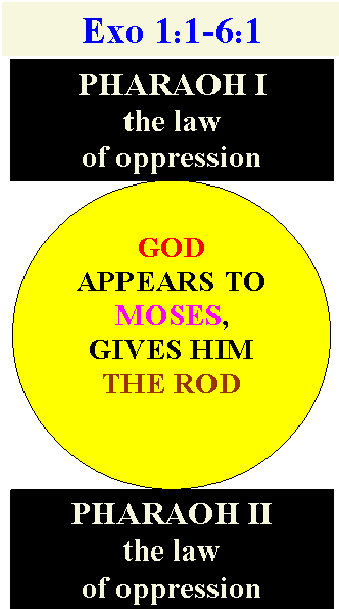
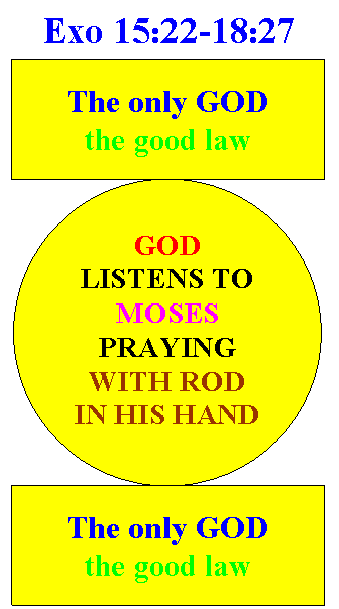
It is the detailed discussion of these external pericopes to which the three following elements of this presentation are devoted. Below is shown a simple eventual schema which helps Dear Reader to quickly understand these successive stages of the analysis:
Exod27.html
THE THEOCENTRIC METHOD
IN READING THE BOOK OF EXODUS 1–18:
THE DISCOVERY OF THE LITERARY STRUCTURE
OF TWO EXTERNAL PERICOPES
EXO 1,1–6,1 AND EXO 15,22–18,27
To understand the sacred text, and in it its composition given for it by the hagiographer–editor, one ought to read it theocentrically, with particular attention being paid to this places in the text where God is the subject of acts or where He says and reveals something (and, of course, what He says).
As a result of the theocentric persistent reading of the sacred Hebrew text of the Book of Exodus 1–18, both pericopes reveal the following literary structure:
The first pericope (1,1–6,1):
Part 1.: | Israel groans in the bondage of cruel Pharaoh “1”; |
|---|---|
Part 2.: | God of Fathers appears to Moses three times. In the first revelation He bestows on him THE ROD OF GOD to perform signs–miracles, and successively shows him the plan to lead out the Israelites, its own People, of the Egyptian slavery. |
Part 3.: | Israel groans in the bondage of cruel Pharaoh “2”; |
The last pericope (15,22–18,27):
Part 1.: | God leads His own People in the way of cognition of His mercy and His Law, |
|---|---|
Part 2.: | God shows to the People that Moses is his chosen one, the leader of Israel, equipped by him with the attribute of the authority – THE ROD OF GOD: through Moses, equipped with the rod, God brings forth water from the rock, gives victory over a deadly enemy – the Amalekites. |
Part 3.: | God leads His own People to be thankful to Him and to know His Law. |
Both pericopes have a concentric structure: they consist of three parts, from which external ones express the analogous thought, mainly concerning mutual relation between God and People (God protects His own People in the situation of threat and their cry for help; God patiently educates his own People being too inclined to complaining); the central part in both pericopes shows a special divine revelation connected with the person of Moses equipped with the attribute of the authority and the sign of the God’s care – with the rod of God.
This concentric structure of both pericopes shows the unquestionable central place of God in history, the meaning of His Person and His salvation plan for the exit of Israel from the bondage, the necessity of the obedience and trust to God and to His servant Moses, even in the situation of an ostensive absence of God or an ostensive destruction of His plans by the enemy.
The identical structure of both external pericopes also points out on the necessity of understanding them as parallel elements, as a clamp containing the other four elements of the literary structure of Exodus 1–18 – what is discussed in the next item of this presentation.
Exod28.html
PERICOPES EXO 1,1–6,1 AND EXO 15,22–18,27
AS THE RHETORICAL INCLUSION
FOR THE BOOK OF EXODUS 1–18
The identical structure of both external pericopes also points out on the necessity of understanding them as parallel elements, as a clamp containing the other four elements of the literary structure of Exodus 1–18.
Also to the same conclusion leads the following specification in the below table:
- Some fundamental problems that have their source in the first pericope, and its solution in the last one,
- pairs of some contrastingly different situations of the first and last pericope.
תַּעַבְדוּן אֶת־הָאֱלֹהִים עַל הָהָר הַזֶּה Pericope 1,1-6,1 תַּעַבְדוּן אֶת־הָאֱלֹהִים עַל הָהָר הַזֶּה | תַּעַבְדוּן אֶת־הָאֱלֹהִים עַל הָהָר הַזֶּה Pericope 15,22-18,27 תַּעַבְדוּן אֶת־הָאֱלֹהִים עַל הָהָר הַזֶּה |
|---|---|
God said to Moses during the first revelation at Horeb that the proof for him that it was God who had sent him to lead Israel out of Egypt would be their worship service for God on this mountain (i.e. on Horeb – 3,1) (3,12): עַל הָהָר הַזֶּה אֶת־הָאֱלֹהִים תַּעַבְדוּן | Israel was camping beneath the Mount Horeb, the mountain of God (cf. 3,1;17,6: brexo; 3,1.12;18,5: rh;) when Jethro arrived. Jethro took a burnt offerings and sacrifices for God. Aaron and all the elders of Israel came to eat bread with Moses’ father in law before God (18,12): לֶאֱכָל־לֶחֶם עִם־חֹתֵן מֹשֶׁה לִפְנֵי הָאֱלֹהִים |
| Jethro took care of the Moses-escapee, and allowed him to eat daily bread (לֶחֶם – 2,20) | Jethro made offerings to God, and it is a sacrificial bread (לֶחֶם) that Moses, Aaron and the elders of Israel ate with him (18,12) |
| Jethro gave Moses his daughter Zipporah to be his wife, and she bore him two sons (2,21; 4,20). | Jethro brought to Moses his wife Zipporah and his two sons, whom Moses had sent back to him (18,2) probably for that reason not to expose his family to a risk of death during the departure out of Egypt. Their arrival shows that now it has already come the time of peace, after the time of fight for the life of the nation. |
The name of the first son of Moses was Gershom (גֵּרְשֹׁם), for he said, “I am a stranger in foreign land (2,22)”. The name of the second son wasn’t here given. | The name of the first son of Moses was Gershom (גֵּרְשֹׁם), for he said, “I am a stranger in foreign land (2,22)”. The name of the second son was Eliezer (אֱלִיעֶזֶר), for Moses said, “My father’s God is my helper; he has rescued me from Pharaoh’s sword” (18,4). These names represent the extreme situations: the situation described in the first pericope is characterized by the name of the first son, the situation described in the last pericope is characterized by the name of the second (i.e. the last) son. |
| Jethro allowed Moses to go to Egypjvp t after this, when God had appeared to Moses on Horeb and ordered him to go and lead Israel out of Egypt; Jethro wished him well (4,18). | Jethro came to know what God had done for Israel. He gratefully praises God for the Israel’s liberation from the hand of Pharaoh and for the care of the People in the time of the whole way (18,1.8-12). |
| The bickering Israelites call in question the right of Moses to be their mediator (2,14: לְאִישׁ שַׂר וְשֹׁפֵט – Who made you a ruler and judge over us?). | Moses judges (שׁפט – 18,13. 16) the Israelites. Moses appointed superiors (שַׂר – 18,21. 25), granting them the right to judge (שׁפט – 18,22) every small matter. |
| Pharaoh “1” and Pharaoh “2” oppresses Israelites, gives them task (חֹק – 5,14) of work above man’s power, commands (צוה – 1,22; 5,6;) them so to annihilate them (1,10.16.22). | God gives laws (חֹק – 15,25.26; 18,16.20) to Israel; He commands (צוה – 16,16. 24. 32. 34; 18,23) her for her good; He wants to be her healer (15,26). |
Pharaoh “2” orders to gather (לקח – 5,11) straw (תֶּבֶן – 5,7ab.10. 11.12.13.16.18), stubble (קַשׁ – 5,12) to make bricks. These were bricks for the Pharaoh’s building. | God commands to gather (לקח – 16,16) food: מָן – manna: 16,31.33.35ab, i.e. לֶחֶם – bread: 16,4.8.12.15.22.29.32; שׂלָו – quails: 16,13, i.e., בָּשָׂר – flesh: 16,8.12. It was food for the people. God cared not only for the food but also for the drinking water for the People (15,22-25.27; 17,1-7). |
Pharaoh “2” gives Israelites a cruel, murderous daily norm (דְּבַר־יוֹם בְּיוֹמוֹ – 5,13.19) of gathering. | God gives for the People the natural daily norm (דְּבַר־יוֹם בְּיוֹמוֹ – 16,4) of gathering – according to what everybody can eat. |
| Pharaoh “1” and Pharaoh “2” torments the People with the daily work, with the work without a break (1,8-14; 5,6-19). Pharaoh “2” forbids the People to celebrate a feast to God, adjudging the cult as the sign of their laziness, as taking them away from their work (5,4-5. 8-9. 17). By forbidding the supply of straw he makes the work impossible to do (5,7-8. 10-11. 13. 16). | God commands the People to rest every seven days, and He gives them opportunity to fulfill that order (16,23-30). This free time has to be the Sabbath to the God. |
The analysis carried out in the above table revealed that the pericopes Exo 1,1-6,1 and Exo 15,22-18,27 are elements referring to each other regarding their content and concentric structure.
In the literary structure of Exo 1-18, these pericopes-elements constitute the frame for the whole text, that is to say the inclusion – so typical element of Hebrew rhetoric!
Exod29.html
THE RESULT OF ANALYSIS
OF THE BOOK OF EXODUS 1–18
WITH THE THEOCENTRIC METHOD
recapitulation
It is worth to take a look once again at the Previously presented result of theocentric analyses. From among six pericopes discovered in Exo 1–18, external ones 1,1–6,1 i 15,22–18,27 have the same basic literary structure, and they together constitute the inclusion, the literary clamp for the entirety of the text of Exo 1,1–18,27. Therefore Exo 1–18 is – in the intention of the inspired its hagiographer–editor – a logical entirety:
Exod30.html
THE LITERARY STRUCTURE
OF THE BOOK OF EXODUS 1-18:
six pericopes and their chiastic thematic relation.
The presentation of the structure of the remaining pericopes is now omitted – this problem may be supplemented in the future. Now, however, the totality of the structure of Exo 1-18 will be shown.
It is ascertained as a result of research with the theocentric method that the Book of Exodus 1-18 at the level of content:
- is composed of six pericopes:
1:1-6:1; 6:2-11:10; 12:1-13:16; 13:17-14:31; 15:1-21; 15:22-18:27, - each pericope separately communicates a strictly definite topic, which is different from topics of other pericopes,
- consecutive pericopes serve to exhibit consecutive stages of the plan of God liberating the People of Israel from Egypt,
- pairs of pericopes: 1st and 6th; 2nd and 5th; 3rd and 4th are linked by the relation “announcement – fulfillment,”
- the literary entirety, composed of six pericopes, has a concentric structure A B C C’ B’ A’.
Exod31.html
THE LITERARY STRUCTURE
OF THE BOOK OF EXODUS 1-18:
six pericopes and their chiastic lexical relation: introduction.
It is found as a result of the theocentric method research that in the level of the thematic content of pericopes, the literary structure of Exo 1-18 is a concentric one; thus, it has a feature typical for Hebrew literary compositions.
It turns out that such a concentric structure is hidden deeper – in the lexical level, namely:
if in each of the six pericopes separately, one examines the number of Hebrew words occurring in one of the two groups chosen in the comprehensive research:
- forms of future tenses: either in the imperfect or in the perfect with waw consecutive, or in the imperative,
- forms of past tenses: either in the perfect or in the imperfect with waw consecutive,
the following results are obtained [1]:
| words in past tenses *@v?{?pw}* | words in future tenses *@v?{?ivq}* | words in past tenses in relation to sum of two groups of tenses (in %) | words in future tenses in relation to sum of two groups of tenses (in %) | sum | |
|---|---|---|---|---|---|
| I | 264 | 164 | 62 % | 38 % | 100 % |
| II | 253 | 200 | 56 % | 44 % | 100 % |
| III | 60 | 110 | 35 % | 65 % | 100 % |
| IV | 71 | 36 | 66 % | 34 % | 100 % |
| V | 33 | 26 | 56 % | 44 % | 100 % |
| VI | 159 | 98 | 62 % | 38 % | 100 % |
These relations can also be presented in the bar graph form – it is shown in the next step of this presentation.
Exod32.html
THE LITERARY STRUCTURE
OF THE BOOK OF EXODUS 1-18:
six pericopes and their chiastic lexical relation: the bar graph.
- red bars concern the past’s words – regarding past events
- blue bar concerns the future’s words – regarding future events
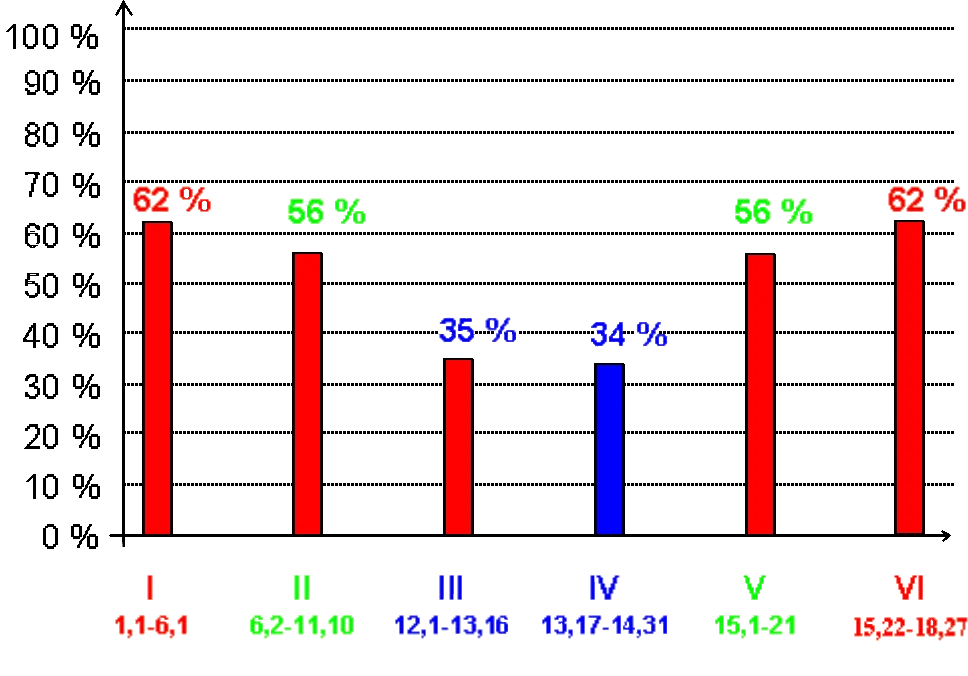
The table and the bar graph show that:
- external pericopes I and VI have the same percentage of words in the past tenses (62%) and the future tenses (38%)
- pericopes II and V have the same percentage of words in the past tenses (56%) and the future tenses (44%);
- Central pericopes III and IV are characterized by an even more interesting relationship (in a very good mathematical approximation):
- the percentage of words in the past tenses in the pericope III = the percentage of words in the future tenses in the pericope IV (35% almost equals 34% )
- the percentage of words in the future tenses in the pericope III = the percentage of words in the past tenses in the pericope IV (65% almost equals 66%)
Thanks to these numerical dependencies, the arrangement of six pericopes is a concentric structure A B C C’ B’ A’; in this case biblical scholars say that it is exactly the chiasmus [1] – a special type of the concentric structure. Such a structure is typical for Hebrews.
Dear Reader!
At the actual stage of this presentation, we know a lot about the literary structure of the Book of Exodus 1-18. In the next stage, it will be shown the identity of this literary structure with the structure of ancient Hittite treaties of the 16th century before Christ.
Exod33.html
THE LITERARY STRUCTURE
OF THE BOOK OF EXODUS 1-18
AND THE LITERARY STRUCTURE
OF ANCIENT HITTITE TREATIES
introduction
As a result of the investigations, it was found that the structure of six consecutive pericopes (literary elements) of the Book of Exodus 1-18 fulfills the requirements imposed by the literary scheme… of the Hittite alliance treaties discovered on the clay tablets.
Alliance treaties are official political documents written by scribes (specially prepared for this task) after the conclusion of the alliance between two countries. These treaties, being preserved in sanctuaries of both allied countries, had to testify about contracting the pact – the alliance – in this case between Hittites and other countries.
In the period from the sixteenth to the twelfth century before Christ, the treaties had to have six consecutive parts, namely:
- The historic prologue showing a contribution of a stronger partner to the life of a weaker partner in their hitherto existing history – that is until the day when they met to perform the four-element ceremonial of covenant-making, what had to be accomplished in four consecutive steps: 2, 3, 4 and 5.
- Presentation of two covenant partners, in this the show, full of eastern exaggeration, of the majesty of a stronger partner and his magnanimous promise of a gift-giving for a weaker partner (for example, the bestowal of a territory).
- Presentation of the basic covenant law, whose aim was to make the weaker partner remembering about the undertaken allegiance relation (it was determined here how often and in which solemnity the weaker partner is obligated to read the covenant treaty publicly and to remind himself and his servants of the duties concerning the stronger partner).
- The undertaking of the already irrevocable act of covenant-making (cutting). It was performed in the following way: two partners passed between halves of split (cut) animals; going on the ground soaked with their blood, they were passing as if through the sphere of death – in fact, the alliance had to be indissoluble, for life-and-death.
- Fulfillment by the suzerain and the vassal of the promises made at the beginning of the ceremony. Commemoration of the fact that the covenant had been made and that the promises had been fulfilled, often marked by the raising of a mound or the planting of a tree, and by the composition of a hymn.
- The description of the laws governing the daily relationships between two covenant partners.
Like a clamp, the external elements of the literary structure of the document (of the treaty) embraced the four central elements.
The central elements were not only a fruit of the literary talent but a report of the covenant-making ceremony, really accomplished by both partners. This ceremony was composed exactly according to the four consecutive elements 2, 3, 4, and 5 – it was performed according to the universally binding political-religious ceremonial.
Exod34.html
THE LITERARY STRUCTURE
OF THE BOOK OF EXODUS 1-18
AND THE LITERARY STRUCTURE
OF ANCIENT HITTITE TREATIES
details
As a result of the investigations, it was found that the structure of six consecutive pericopes of the Book of Exodus 1-18 fulfills the requirements imposed by the literary scheme of the Hittite alliance treaties:
- Exo 1:1-6:1: the description of the constant God’s care of Israel in the situation of the threat of the existence of the Nation in the time preceding God’s revelation to Moses in Egypt, i.e., the revelation, described since Exo 6:2, which begins the four-element ceremonial of the covenant-making.
- Exo 6:2-11:10:
- Exo 6:2-8: presentation of the stronger partner, his name, his relations with the ancestors of the weaker partner
- God gives promises to Israel:
- Exo 6:7: to make a covenant:
“I will take you as my people, and I will be your God”,
what is tantamount to the expression:
“I will make the alliance with you”; - Exo 6:6-8: to give them freedom;
- Exo 6:8: to give them the land of Canaan for their possession;
- Exo 6:7: to make a covenant:
- Exo 6:14-26: the genealogy of Moses and Aaron – it is the presentation of the weaker partner of the covenant,
- Exo 7:8-11:10: show of majesty and magnificence and power of the stronger partner of the covenant – the ten miraculous signs.
- Exo 12:1-13:16: God gives the basic covenant law for Israel: in honor of God, Israel has to celebrate the Passover annually, starting from the dusk of the fourteenth day of the month Abib, and to eat without leaven throughout seven days after. The narrative elements (in this, the description of the killing of the firstborn sons of Egypt and the description of Israel’s departure out of bondage – Exo 12:29-42) serve as an explanation of this law.
- Exo 13:17-14:31: the act of the covenant-making (cutting) – God leads Israel from the place of consumption of the Passover meal to the Sea of Reeds (the Red Sea), and the two partners pass between its split waters as between the halves of an animal, in accordance with the ceremonial rite (the legitimacy of this understanding is confirmed by perfectly understood text of Isa 51:9-10 – click, please, to read the discussion about this parallelism, which is contained in my doctoral thesis: it is necessary to choose there the pages 209-217).
- Exo 15:1-21: the commemoration of the fact of the ratification of the covenant and of the fulfillment of its obligations.
- Exo 15:22-18:27: God’s orders, prohibitions, blessing and anger towards Israel, protection from enemies; the appointment of the judges of the People; the thanksgiving to God for the contracted covenant and for His redemptive intervention.
Exod35.html
THE LITERARY STRUCTURE
OF THE BOOK OF EXODUS 1–18
AND THE LITERARY STRUCTURE
OF ANCIENT HITTITE TREATIES
the possibility of the reduction to 4 elements
As a result of the investigations it was found that the structure of six consecutive pericopes of the Book of Exodus 1–18 fulfills the requirements imposed by the literary scheme of the Hittite alliance treaties. At the same time, you can see that:
- The 1st and the 2nd pericope in some respects are the entirety – they show the magnificence of God, His love for Israel, His promises of the covenant: self–presentation of God as the king–suzerain, as the king full of glory, splendour and majesty; presentation of the contributions of God to the life of Israel–vassal within the framework of the history preceding the ratification of the Passover/exodus covenant; the God’s initiation of the ratification ceremony of the covenant with Israel, being connected with the promise of the bestowal of the Land of Canaan upon her.
- Also the 5th and the 6th pericope in some respects are the entirety – they show how the magnificent God fulfils the promises of the alliance after its ratification, and how the bestowed Israel inscribes into her memory the doings of God who as the partner of the alliance is her protector against enemies, hunger and thirst; he is a patient teacher of the covenant law; he leads Israel to Himself, to the life in the land He promised to their fathers.
For that reason the structure of Exod 1–18 can be reduced to four elements:
| A: Exo 1,1–11,10: | God presents himself as the king full of power and majesty, and initiates alliance with Israel in her situation of being slave in Egypt, undertakes the obligation to give her the Land of Canaan as a possession. |
|---|---|
| B: Exo 12,1–13,16: | God gives Israel the law of the Passover / Exodus covenant; Israel accepts the law given her. |
| C: Exo 13,17–14,31: | God makes covenant with Israel by the act of leading her through the desert and through the slotted sea. |
| D: Exo 15,1–18,27: | Israel glorifies God, remembering that He has given her His blessing, i.e. freedom and land, food and water, knowledge of Him and of His law. |
The possibility of making such a thematic reduction was perceived at the beginning of Israel as the People of the Lord; it became the principle for incorporation of the history of Exod 1–18 into the Passover ritual, what is being discussed in the next few points of the presentation.
Exod36.html
PASSOVER:
the rite of the Passover in the light of “The Passover Haggadah”
The Passover Haggadah”[1] – “הַגָּדָה שֶל פֶסַח” –
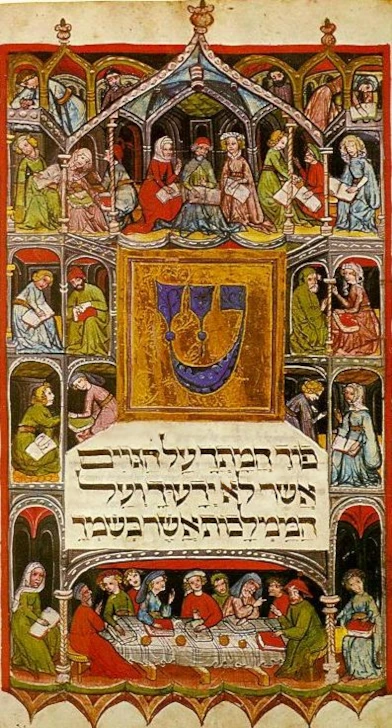
mentions the four ritual cups of wine constituting the basic structure of the rite. “Haggadah” is a liturgical book which contains specific prayers, wisdom teachings, songs, symbolic acts (the washing of hands, the eating of symbolic dishes…), which are performed in order, as being attributed to successive fourteen parts of the rite. “Haggadah” is a Jewish book of liturgy of the Paschal Vigil [2]. For this reason, the analysis of the text of “Haggadah” in its original Hebrew / Aramaic recording will be one of the main exegetical tasks for every one who wants to come to know the logic of the Passover rite.
The text of “Haggadah” came into being gradually, through many centuries [3]. Its first version was compiled probably between the second half of the 2nd century AC and the end of the 4th century AC.
It is believed that although the currently known ancient text of “Haggadah of Pesach” is later than the destruction of the Jerusalem Temple (which took place in the 70th year after Christ), however basic part of the Hebrew and Aramaic text and key ideas of the whole book are prior to the Jesus Christ’s coming to the world [4].
“Haggadot” (the plural form of “Haggadah”) of the 8th century, preserved in the Genizah in Cairo, are known only in fragments. On their basis, however, it is impossible to come to know the whole text of that period.
The oldest complete readable manuscript of the “Haggadah” is found in a prayer book compiled by Saadia Gaon (the head of the Academy at Sura) in the 10th century.
In the 13th century, Polish or German Jews added final songs to that text [5].
From the 13th century also begins considerable growth of the commonness of custom of the use of “Haggadah” as the separate liturgical book to perform the Passover in Jewish homes [6].
The oldest confirmed printed copy of “Haggadah” dates from 1486 year, from Soncino in Italy.
Since several centuries, “Pesach Haggadot” are widely printed. Often richly decorated and illustrated, this little books contain a description of successive steps of the Passover liturgy: of deeds and word – of the rite. The explanation of these successive holy acts is often added in “Haggadot”. Attention is focused not only on each doing or word of the celebrated Passover, but also on their prescribed order, which in Hebrew is expressed by the word “seder” (סֵדֶר) [7].
The same term is also used:
- as the term equivalent to “Passover Haggadah”,
- as the name of the special plate, where the six ritual foods are placed on,
- as the liturgy leader’s name, which indicates his essential role to faithfully preserve the order of the successive acts of the Passover liturgy.
See also: K. Kohler, The Yemen Haggadah, “The American Journal of Semitic Languages and Literatures”, vol. 13, No. 3 (1897), 234-239; B. S. Childs, The Book of Exodus. A Critical Theological Commentary, Philadelphia 1974, 208-209.
Exod37.html
THE RITE OF THE PASSOVER ACCORDING TO “HAGGADAH”
the main problem statement
Particular editions of “The Passover Haggadah”, as well as its discussion, can differ only in details which have the source in the historic development of the paschal liturgy over the centuries, among Jews living in geographically distant regions of the world. The basic rite of the Passover, given by so many sources, is preserved [1]. Larger differences occur only at the end of the Seder – among Sephardic Jews in the liturgy of Passover are far less different final songs than among Ashkenazi Jews [2].
“The Passover Haggadah” allows to preserve the order of the paschal meal (being characterized as a sequence of the liturgical words and actions attributed to successive fourteen parts of the rite) to accomplish the principal liturgical message of the four cups of wine being drunk successively in a determined order. “Haggada” however does not inform, where the liturgical acts of the first cup have their finish and simultaneously the acts of the second cup begin; where the acts of the second cup have their finish and the acts of the third cup begin; where the acts of the third cup have their finish and the acts of the fourth cup begin.
However, analysis conducted by the author of the present publication showed that unambiguous partition is possible – it is presented on the next screen.
הגדה של פסח The Passover Haggadah. A faithful English rendering by A. Regelson, illustrated by Z. Kleinman, New York 1965;
הגדה של פסח Passover Haggadah with a new translation by Chaim Raphael, New York 1972;
הַגָּדָה שֶל פֶסַח Hagada na Pesach. Na język polski przełożył Dyr. Salomon Spitzer, Tel-Aviv 1972;
הגדה שׁל פסח Hagada. Opowiadania o wyjściu Izraelitów z Egiptu na pierwsze dwa wieczory święta Pesach. M. Zalcman Bookshop’s Publisher, Vienna 1927, 33. “Haggadah” is available now in the “Bibliofilska Edycja Reprintów” as the reprint made from the copy of a private collection in the printing enterprise Interdruck GmbH in Leipzig, Warszawa 1991;
הַגָּדָה שֶל פֶסַח S pomocí Bozí nová prazská pesachová HAGADA s poučným výkladem a v překladu rabi Efraima K. Sidona a s učeným doslovm doktora Bedřicka Noska, Praga 1996;
הגדה של פסח Haggada de Pessah, Brussels 1999;
L. Ligier, Textus Liturgiae Judeorum, [in:] A. Hänggi, I. Pahl, Prex Eucharistica: Textus e variis antiquoribus selecti, Fribourg 1968, 1-57, and in this p. 13-34: Sédèr Haggadah šèl Pèsah seu ordo narrationis Paschae;
S. Pecaric (red.) הגדה של פסח Hagada na Pesach i Pieśń nad Pieśniami, Kraków 2002, 62-230;
S. P. De Vries, Obrzędy i symbole Żydów, translated by A. Borowski, Kraków 1999, 181-189;
J. Kanofsky, Przewodnik Pesachowy Fundacji Ronalda S. Laudera. Pesach 5763 / 2003, Warszawa 2003;
R. Cantalamessa, Pascha naszego zbawienia. Tradycje paschalne Biblii i pierwotnego Kościoła, translated by M. Brzezinka, Kraków 1998, 37-41;
J. Drozd, Ostatnia Wieczerza nową Paschą, 39-44;
The Passover Hagadah - the English text of the Passover Hagadah, published by Kehot Publication Society, and being made available in electronic form by Chabad Lubavitch in Cyberspace ← please click here!
A. Cała, Sefardyjczycy, [in:] A. Cała, H. Węgrzynek, G. Zalewska, Historia i kultura Żydów polskich. Słownik, Warszawa 2000, 300-301: Sephardi – Jews who are descended from the Iberian Peninsula (Spain, Portugal).They had to leave Spain in 1492, so they went to North Africa, Near East and Balkans, France, Italy, Netherlands, America.
See also Sephardi Jews – in Wikipedia.
A. Cała, Aszkenazyjczycy, [in:] ibidem, 16: Ashkenazim – Jews who originally descended from Germany; now this term includes the Jews from Central and Eastern Europe.
See also Ashkenazim – in Wikipedia.
Exod38.html
THE RITE OF THE PASSOVER
ACCORDING TO “THE HAGGADAH” FROM 1927 YEAR [1],
divided into four coloured sections by the author of the presentation
| 1. Kaddesh | The blessing | קַדֵּשׁ |
|---|---|---|
| 2. Urechatz | The washing of hands | וּרְהַץ |
| 3. Karpas | The eating of the parsley (having dipped it in the salty water) | כַּרְפַּס |
| 4. Yachatz | The breaking of the middle matzah to have afikoman | יַחַץ |
| 5. Maggid | Telling the story of the Exodus from Egypt | מַגִּיד |
| 6. Rachtzah | The second washing of the hands | רַחַץ |
| 7. Motzi and Matzah | The two blessings over the matzah | מוֹצִיא מַצָה |
| 8. Maror | The eating of the bitter herb (having dipped it in the salty water) | מָרוֹר |
| 9. Korekh | Eating of sandwich made with matzah bitter herb and charoset | כּוֹרֵךְ |
| 10. Shulchan Orech | The eating of the festive meal | שֻׁלְחָן עוֹרֵךְ |
| 11. Tzafun | The eating of the afikoman. | צָפוּן |
| 12. Barekh | The thanksgiving for the food; prayers for Elijah and Messiah | בָּרֵךְ |
| 13. Hallel | The recitation of the second part of Hallel | הַלֵּל |
| 14. Nirtzah | The final singing | נִרְצָה |
Remark: the following changes are introduced to the original text of the edition of 1927 year to show the logic of this division:
- „3. The eating of the parsley” – to this was added: “having dipped in the salty water”,
„8. The eating of the bitter herb” – to this was added: “having dipped it in the salty water”.
It is evident that section I (red colour) and II (green colour) have the same layout – in each section there are parts: the blessing; the washing of hands; the eating of the herb after having dipped it in the salty water.
Similarly in both sections the fourth part is connected with matzah, so
“4. The breaking of the middle matzah” was changed to equivalent:
“4. The breaking of the middle matzah to have afikoman”,
what harmonizes with:
“11. The eating of the afikoman”. - “12. The thanksgiving prayers after the eating” was corrected to:
“12. The thanksgiving for the food” (in this especially for the unleavened bread of Exodus from Egypt!); and it was added: “prayers for Elijah and Messiah” (for their arrival and renewal of the original Exodus; for all Israel to be introduced to the new reality, to the expected time of Messiah – Messiah is expected each year during the Passover). - The white highlighted text is for double occurrence of the afikoman (in the point 4. and 11.). It is worth noting that afikoman is very important, since it divides the set of 14 parts of the rite of the Passover into 4 sections; each section consists of three parts:
1+2+3 4 5+6+7 8+9+10 11 12+13+14. - It should be noted, however, that the division in respect to the afikoman is not the most typical for the rite of the Passover. The fundamental division is visualised by four colours in the table rows, showing the belongingness of each of the fourteen parts to one of the four particular consecutive main sections of the rite, connected with the four consecutive cups of wine constituting the basic structure of the rite.
- The first section is concentrated on telling the Israel’s history beginning from the history of Patriarches; the special place occupies here the description of the Israel’s miserable situation in Egypt (hence the eating of the parsley after having dipped it in the salty water: participants have to existentially “enter” into the situation of bitter tears of slavery, of being the lowest social layer, close to the ground – as a parsley which is a miserable plant that grows close to the ground; presentation of the wonderful intervention of God in the interest of Israel in Egypt crowns this history, and a narrative of the leader turns into a prayerful enumeration of the fifteen from among many benefits which God has shown them during the exodus from Egypt; at the end the singing of the first part of Hallel (i.e. Psa 113-114) expresses the gratitude of Israel for the God’s intervention.
However the singing is preceded still by an explanation of the liturgical signs which will take place right in the second section of the Passover rite: the leader explains the meaning of the eating of the unleavened bread, the bitter herbs and the paschal lamb (currently the lamb is not eaten because there is not the temple in Jerusalem – and only in the temple in Jerusalem one can sacrifice the lamb for the Passover).
Therefore it should be emphasized that the first section of the Passover is devoted to the teaching, the telling, the demonstrating of the magnitude of God as a faithful partner of the covenant, and to the showing of His requirements – thence in the first section is still the explanation of what in the second section will be made as ordered by the Lord. - The second section of the Passover rite in its official fragment is the most modest, what does not mean it is unimportant. Quite the reverse, the four consecutive parts (in the above table they have numbers: 6, 7, 8 and 9) are the fulfilment of the Passover law: every participant has to eat matzah, bitter herbs dipped in salty water, and matzah with bitter herbs, fulfilling in this way the God’s command concerning the Passover lamb: Exo 12,8 “And they shall eat the flesh in that night, roast with fire, and unleavened bread; with bitter herbs they shall eat it”. Only after the fulfillment of this acts comes the time for an abundant holiday meal, for the supper not being governed by the Passover law.
- The third and the fourth section of the rite will be presented on the next screens. However it should already be noted that in all comments the eating of the afikoman is erroneously interpreted as the eating of the dessert after the supper being just finished; and the prayers associated with the eating of the afikoman are simply interpreted as the thanksgiving for the finished supper. Therefore in the third section in the above table, the very significant correction of the text issued in 1927 was made.
Originally the above 14-part schema of the Passover seder has not been divided into the four sections corresponding to the four cups constituting this structure. Although it is not an easy task, but it is a feasible and necessary one to understand the primary rite of the Passover.
There exists also the seder composed of 15 parts, which differs from the above one only in this, that the part 7. (מוֹצִיא מַצָה) is divided into two parts: 7. (מוֹצִיא) and 8. (מַצָה).
Exod39.html
ןTHE RITE OF THE PASSOVER, THE THIRD SECTION:ן
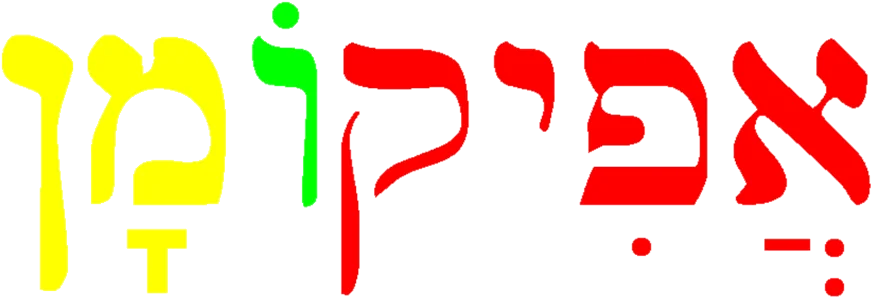
AFIKOMAN AS THE MANNA (מָן) OF THE COVENANT MAKING
ןBETWEEN GOD AND ISRAELן
ןDURING THEIR PASSAGE BETWEEN DIVIDEDן
WATERS OF THE SEA, UPON ITS (וֹ) BOTTOM (אֲפִיק)
Exod40.html
THE RITE OF THE PASSOVER, THE THIRD SECTION: biblical texts

NAB Exo 12,34–39 34 The people, therefore, took their dough before it was leavened, in their kneading bowls wrapped in their cloaks on their shoulders. 35 The Israelites did as Moses had commanded: they asked the Egyptians for articles of silver and gold and for clothing. 36 The Lord indeed had made the Egyptians so well–disposed toward the people that they let them have whatever they asked for. Thus did they despoil the Egyptians. 37 The Israelites set out from Rameses for Succoth, about six hundred thousand men on foot, not counting the children. 38 A crowd of mixed ancestry also went up with them, besides their livestock, very numerous flocks and herds. 39 Since the dough they had brought out of Egypt was not leavened, they baked it into unleavened loaves. They had been rushed out of Egypt and had no opportunity even to prepare food for the journey.
13,21 The Lord preceded them, in the daytime by means of a column of cloud to show them the way, and at night by means of a column of fire to give them light. Thus they could travel both day and night.
14,19–22 19 The angel of God, who had been leading Israel’s camp, now moved and went around behind them. The column of cloud also, leaving the front, took up its place behind them, 20 so that it came between the camp of the Egyptians and that of Israel. But the cloud now became dark, and thus the night passed without the rival camps coming any closer together all night long. 21 Then Moses stretched out his hand over the sea, and the Lord swept the sea with a strong east wind throughout the night and so turned it into dry land. When the water was thus divided, 22 the Israelites marched into the midst of the sea on dry land, with the water like a wall to their right and to their left.
14,24 24 In the night watch just before dawn the Lord cast through the column of fire and of cloud upon the Egyptian force a glance that threw it into a panic.
Exod41.html
THE DESCRIPTION OF THE COVENANT MAKING BETWEEN GOD AND ABRAM
Gen 15,1–20
in this especially Gen 15,17f – click, please
NABGen 15,1–21 1 Some time after these events, this word of the Lord came to Abram in a vision: “Fear not, Abram! I am your shield; I will make your reward very great.” 2 But Abram said, “O Lord God, what good will your gifts be, if I keep on being childless and have as my heir the steward of my house, Eliezer?” 3 Abram continued, “See, you have given me no offspring, and so one of my servants will be my heir.” 4 Then the word of the Lord came to him: “No, that one shall not be your heir; your own issue shall be your heir.” 5 He took him outside and said: “Look up at the sky and count the stars, if you can. Just so,” he added, “shall your descendants be.” 6 Abram put his faith in the Lord, who credited it to him as an act of righteousness. 7 He then said to him, “I am the Lord who brought you from Ur of the Chaldeans to give you this land as a possession.” 8 “O Lord God,” he asked, “How am I to know that I shall possess it?” 9 He answered him, “Bring me a three–year–old heifer, a three–year–old she–goat, a three–year–old ram, a turtle–dove, and a young pigeon.” 10 He brought him all these, split them in two, and placed each half opposite the other; but the birds he did not cut up. 11 Birds of prey swooped down on the carcasses, but Abram stayed with them.
12 As the sun was about to set, a trance fell upon Abram, and a deep, terrifying darkness enveloped him. 13 Then the Lord said to Abram: “Know for certain that your descendants shall be aliens in a land not their own, where they shall be enslaved and oppressed for four hundred years. 14 But I will bring judgment on the nation they must serve, and in the end they will depart with great wealth. 15 You, however, shall join your forefathers in peace; you shall be buried at a contented old age. 16 In the fourth time–span the others shall come back here; the wickedness of the Amorites will not have reached its full measure until then.” 17 When the sun had set and it was dark, there appeared a smoking brazier and flaming torch, which passed between those pieces. 18 It was on that occasion that the Lord made a covenant with Abram, saying: “To your descendants I give this land, from the Wadi of Egypt to the Great River (the Euphrates), 19 the land of the Kenites, the Kenizzites, the Kadmonites, 20 the Hittites, the Perizzites, the Rephaim, 21 the Amorites, the Canaanites, the Girgashites, and the Jebusites.”
Exod42.html
THE RITE OF THE PASSOVER
IN THE LIGHT OF THE HITTITE CEREMONIAL
OF MAKING THE COVENANT
The structure of the Book of Exodus 1–18 and accordingly the structure of the law pericope (Exo 12,1–13,16) are the skeleton for the Seder (the rite) of the Passover, celebrated by all Israel on the night of the 15th of Abib every year in honor of the Lord as the sovereign of Israel. The celebration of the Passover is the every–time actualisation (i.e. “making–present”) of the covenant being made by the Lord and Israel during the whole time of the departure out of Egypt, described in the Book of Exodus 1–18, especially in the four pericopes: 6,2–11,10; 12,1–13,16; 13,17–14,31; 15,1–21.
| The Lord had been leading Israel out of Egypt in this manner to simultaneously make the covenant with her according to the four–element ceremony of the ancient people of the East. |
Just as the first essential step in the procedure of the covenant making is the presentation of its partners, especially the stronger of them, including his promises for a weaker partner, so in the first pericope (6,2–11,10) and in the first section of the Passover Seder the majesty of the Lord is shown, whose magnitude was revealed by ten miraculous signs, which were made by Him through Moses and Aaron in the land of Egypt, and which are announced by the leader of the Passover Seder in any place of the earth where the liturgy of this holy night is performed.
The covenant law, which in the treaties of the ancient covenants is the next element after the presentation of its partners, is represented by the law pericope (12,1–13,16) in the Book of Exodus, and by the eating of the Passover lamb (which is commanded by the paschal law) in the Passover seder. For the actual impossibility to sacrifice the lamb to the Lord in the Jerusalem temple, the seder contains liturgical substitutive acts, whereat the eating matzah with bitter herbs is the most significant sign, which makes it present what was commanded by the Lord in Egypt and what was fulfilled by the forefathers in Egypt: the consumption of the lamb with unleavened bread and bitter herbs (cf. Exo 12,8).
It should be noted that the description of the Israelites’ departure out of Egypt, contained in the law pericope (Exodus 12,34–39), serves to explain the aim of the Passover law.
The very act of the irrevocable making (cutting) of the covenant, described in the third pericope (13,17–14,31), is made present in the part 3. of the Passover seder: the eating of the unleavened afikoman, and the prayer for the redemptive exodus, the opening of the door, and the prayer for the outpouring of the God’s anger upon the enemies of the people starting the departure out of Egypt – they are the signs of the “made present” passage of the Lord and His People through the desert and between halves of the divided Rahab, i.e. between the divided waters of the Sea of Reeds. The very act of the covenant making is accomplished in the identical form as the covenant of the Lord with Abram (Gen 15,17f ← click please).
Just as after the making of the covenant, performed through the passage between the Sea of Reeds, Israel sang a hymn of praise in honor to the God–Saviour (15,1–21), so in the fourth part of the seder Israel raises powerful Hallel, praising with psalms 114–118 and 136 and with songs Him who is God above all gods, and whose grace for Israel is unfathomable.
This hymn simultaneously:
- it is a form (liturgical!) of the fulfilment of the covenant commitments of the both contracting parties,
- it records in the memory of Israel that: a/ the Lord has made with her the covenant (while passing together with her between the dimidiated waters of the Sea of Reeds), b/ the Lord has already fulfilled His promises which He had announced in the day of the covenant inauguration.
The Lord’s most significant obligation (cf. Exo 6,6–8 ← click) was the Israel’s bestowal of freedom and the land of Canaan; the most important obligation of the People was to give glory and honor to the Lord, what had to be expressed by obedience to His law, especially to the Passover law (see Exo 12,27–28 ← click).The fulfillment of the commitments is already anticipated in verses of songs. Israel, full of joy, inspired by the Spirit of God, already participates in goods which God, the King loving her and the Bridegroom of her, will give her within the framework of the human history only in the future time!
DISCUSSION OF THE COVENANT OBLIGATIONS
WHICH THE GOD UNDERTOOK IN THE RELATION TO ISRAEL
IN EGYPT
(the description of commitments is in pericope 2 being symmetrical to pericope 5 in which the description of the fulfillment of commitments is).
The phrase “And I will take you as my own people, and I will be to you a God” is tantamount to the declaration of will: “Now I want to make a covenant with you”. Right now, God initiates the 4–element ancient ceremonial of the covenant making, whose central act of “cutting” (making) will be fulfilled by the act of the passage of God and Israel between waters of the Sea of Reeds being cut into two halves:
Exo 6,6–8 6 Therefore, say to the Israelites: I am the Lord. I will free you from the forced labor of the Egyptians and will deliver you from their slavery. I will rescue you by my outstretched arm and with mighty acts of judgment. 7 And I will take you as my own people, and I will be to you a God. You will know that I, the Lord, am your God when I free you from the labor of the Egyptians 8 and bring you into the land which I swore to give to Abraham, Isaac and Jacob. I will give it to you as your own possession – I, the Lord!“
THE FULFILLMENT OF THE COVENANT COMMITMENTS
TAKES PLACE JUST AFTER THE PASSAGE OF THE SEA OF REEDS
(what was written in pericope 5 being symmetrical to pericope 2 in which the description of God’s promises is):
God has already fulfilled the given promise, though through her own guilt will Israel fully enter into possession of the land till after forty years. However this is not important now: now in the hymn is performed the complete fulfillment of the covenant obligations, i.e. the both gifts–giving and receiving of gifts take place on the basis of liturgical anticipation of events which historically will be fulfilled after forty years:
NAB Exo 15,13–17 13 In your mercy you led the people you redeemed; in your strength you guided them to your holy dwelling. 14 The nations heard and quaked; anguish gripped the dwellers in Philistia. 15 Then were the princes of Edom dismayed; trembling seized the chieftains of Moab; All the dwellers in Canaan melted away; 16 terror and dread fell upon them. By the might of your arm they were frozen like stone, while your people, o Lord, passed over, while the people you had made your own passed over. 17 And you brought them in and planted them on the mountain of your inheritance – the place where you made your seat, o Lord, the sanctuary, o Lord, which your hands established.
Just now Israel fully acknowledges her belongingness to the Lord as her God:
NAB Exo 15,1–2 ¹ Then Moses and the Israelites sang this song to the Lord: I will sing to the Lord, for he is gloriously triumphant; horse and chariot he has cast into the sea. ² My strength and my courage is the Lord, and he has been my savior. He is my God, I praise him; the God of my father, I extol him.
NAB Exo 15,11 Who is like to you among the gods, o Lord? who is like to you, magnificent in holiness? O terrible in renown, worker of wonders.
NAB Exo 15,18 The Lord shall reign forever and ever.
THE PEOPLE
RECEIVES THE COVENANT LAW AND AGREES TO IT,
WHAT IS WRITTEN WITHIN THE FRAMEWORK OF THE LAW PERICOPE
(Exo 12,1–13,16):
in the paschal night in Egypt for the first time they celebrate in honor to the Lord;
they do the same each year:
NAB Exo 12,27–28 27 you shall reply, ‘This is the Passover sacrifice of the Lord, who passed over the houses of the Israelites in Egypt; when he struck down the Egyptians, he spared our houses.’” Then the people bowed down in worship, 28 and the Israelites went and did as the Lord had commanded Moses and Aaron.
NAB Exo 12,50 All the Israelites did just as the Lord had commanded Moses and Aaron.
Exod43.html
THE PASSOVER RITUAL AS THE “MAKING PRESENT OF”
THE FOUR–PART COVENANT CEREMONY
PERFORMED IN THE FOUR STAGES
OF THE EXODUS FROM EGYPT
It should be emphasized that the paschal seder, having the power of “making present” of the historical ceremonial of making the Passover / exodus covenant, has a very important feature:
- it is not structured on the model of the drama wherein most small successive elements show the course of the successive [1] events of the salvation history accomplished by God for Israel in Egypt;
- it is structured on the model of the treaty wherein each of successive four basic elements has its own topic being different from topics of the other three basic elements.
These four basic elements of the Passover rite are the fulfillment of the four main elements of the ceremonial (rite) of the covenant making:
- presentation of partners and especially of the stronger of them, of all his good deeds performed for the weaker of them, of his promises of the covenant,
- presentation of the basic covenant law, to whose preservation the weaker partner obligates himself,
- undertaking of the already irrevocable act of the covenant making (cutting),
- the recording of the fact of the covenant making and of its stipulation.
Simultaneously these four basic elements of the Passover rite have the power of “making present” of the four main stages of the God’s leading Israel out of the bondage in Egypt:
- the time before the Passover meal: the Lord reveals himself to Moses many times, intervenes in Egypt in the interest of Israel through then miraculous signs,
- the time of the Passover meal: the Lord kills the firstborn sons of Egypt, rescues the Israelites obedient to Him,
- the time after the Passover meal: the Lord brings Israel out of Egypt, leads them to the Sea of Reeds and through its slotted waters to the opposite seaboard,
- the time of the new life of Israel: the Lord through his Spirit arouses the song of glory in the hearts of His own People; the Lord feeds His own People in the way to His mount Horeb: sends manna and quails, gives water from the rock; He gives them victory over their enemies (Amalekites); the Lord bestows upon his own People the wisdom to organize the life of the People.
Thanks to this structure every paschal liturgy performs in a successive manner the task of “making something to be present”: in the four successive stages the paschal liturgy performs it in the relation to the four stages of the ceremonial of making the covenant of God with his own People; this liturgy makes the same in the relation to the four stages of the salvation history.
It is just so because the Lord had been leading Israel out of Egypt in such a way to simultaneously make the covenant with her, and to make it according to the four–element ceremony of the ancient people of the East.
The accomplishment of the each of the four basic elements of the Passover rite might run according to any manner (form), provided that the principal purpose of the each particular element is maintained. The Passover seder, however, states that:
- for the 1st. and 4th. element the principle form is the word (spoken or sung: 1. the paschal Haggadah; 4. the singing of hymns),
- for the 2nd. and 3rd. element the principle form is the eating of the food–symbols (2. the eating of the lamb with unleavened bread and bitter herbs; 3. the eating of the afikoman, enriched with the thankful and suppliant prayers).
Exod44.html
THE LITERARY STRUCTURE
OF THE BOOK OF EXODUS 1–18
AND THE STRUCTURE
OF THE SIX-BRANCHED LAMPSTAND
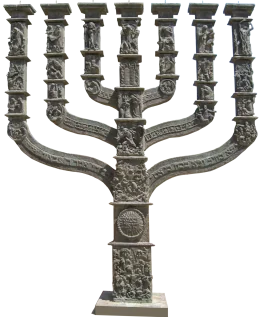
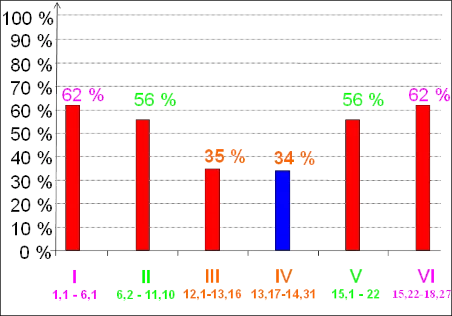
Exo 25,31 “You shall make a lampstand of pure beaten gold – its shaft and branches – with its cups and knobs and petals springing directly from it. 32 six branches are to extend from the sides of the lampstand, three branches on one side, and three on the other. 33 On one branch there are to be three cups, shaped like almond blossoms, each with its knob and petals; on the opposite branch there are to be three cups, shaped like almond blossoms, each with its knob and petals; and so for the six branches that extend from the lampstand. 34 On the shaft there are to be four cups, shaped like almond blossoms, with their knobs and petals, 35 including a knob below each of the three pairs of branches that extend from the lampstand. 36 Their knobs and branches shall so spring from it that the whole will form but a single piece of pure beaten gold. 37 You shall then make seven lamps for it and so set up the lamps that they shed their light on the space in front of the lampstand. 38 These, as well as the trimming shears and trays, must be of pure gold. 39 Use a talent of pure gold for the lampstand and all its appurtenances. 40 See that you make them according to the pattern shown you on the mountain.
As it was shown on the earlier screen of this presentation, if in each of the six pericopes separately one examines the number of Hebrew words occurring in one of the two groups chosen in the comprehensive research:
- forms of future tenses, now then either in the imperfect or in the perfect with waw consecutive, or in the imperative,
- forms of past tenses, now then either in the perfect or in the imperfect with waw consecutive,
then it is obtained the above shown graph for the six pericopes, how similar in the shape to the six-branched menorah!: the longest branches and the longest bars are on both ends; the shortest branches and the shortest bars are in the middle.
It should be noted that there is a striking similarity between the above presented menorah, i.e. the six-branched lampstand, and the six-element literary structure of the Book of Exodus 1-18. This lampstand was one of the most important sacral elements required by God within the framework of the covenant which He made with Israel on the Mount Sinai. It had to be situated inside the Tabernacle – the Holy Sanctuary – in the holy place, outside the veil separating this place from “the Holy of Holies”, where the Ark of the Covenant was placed (cf. Ex 26,35). It can be concluded that similarly the Book of Exodus 1-18 is of the highest sacral rank as the covenant treaty built on the six-element literary structure. It plays such an important role because it is the witness of the first, original covenant between God and Israel – the covenant made, yet before the Sinaitic covenant, during the passage of the both partners between the halves of the divided Sea of Reeds (Red Sea). For that reason in the Sinaitic covenant the six-branched lampstand is to remind that everything what God ordered and to what He committed himself in the Previous covenant, has its irrevocable continuation in the next one (i.e. Sinaitic).
The relationship between the menorah and the covenant is testified also by:
- The Hebrew word “גָּבִיעַ»” (cup), used for the designation of the floral cups in the lampstand (see Exo 25,31.33.34; 37,17.19.20), refers not only to a cup of flower, but also to a cup to drink wine (see Gen 44,2.12.16.17; Jer 35,5); and this in turn meets with the Passover rite, with cups of wine being drunk off successively with the progress of the liturgical action, in order required by the seder service.
- Exo 25,33-34: the amount of the floral cups: 3 + 3 + 3 + 4 + 3 + 3 + 3. The four ritual cups, constituting the Passover rite, occupy the central, preferential place in the construction of the lampstand – the same place as in the six-element literary structure of Exo 1-18 is occupied by the four central pericopes describing the ceremony of the covenant making.
- The Hebrew designation of the six lampstand branches – קָנֶה – is associated with the verb of the same root – קנה – to get, to take. The verb appears in the song, sung by the people immediately after the crossing of the Sea of Reeds:
Exo 15,16: “Terror and dread fell upon them. By the might of your arm they were frozen like stone, while your people, o Lord, passed over, while the people you had gotten (קנה) passed over”. - The word “יָצָא” in Exo 25,32. 33. 35; 37,18. 19. 21 is used to describe that the six branches come out of the lampstand sides; in Exo 1-18 the same word is used to describe that Israelites come out of the Egyptian slavery (Exo 3,10. 11. 12; 6,6. 7. 13. 26. 27. 28; 7,4. 5; 11,8; 12,17. 31. 39. 41. 42. 51; 13,3. 4. 8. 9. 14. 16; 14,8. 11; 15,22; 16,1. 3. 6. 32; 18,1).
It is worth to notice that there is in the Old Testament the law of continuation of the covenant commitments: if God makes one covenant, and afterwards He makes the next one, and then the next one… then in every new covenant not only gives He new requirements, but simultaneously He preserves what was obligatory in all earlier covenants. The God made the covenant with Abram (afterwards called Abraham) three times, about what the Book of Genesis says:
- Gen 15, in this 15,18.
- Gen 17, in this 17,2.9ff.
- Gen 22,1-18, in this 22,16-17.
The obligation of the circumcision, which was imposed upon Abraham and his descendants in the second of these covenants (cf. Gen 17:10-14), was and still is important for every Israelite who wants to remain in this covenant.
Therefore, in the covenant of the Passover / of the Exodus the God only reminds of the necessity of its preservation, and does it in the following manner:
- First, in that “mysterious” event described in Exo 4,24-26 – God didn’t want to kill Moses but to remind him that really the every descendant of Abraham who hadn’t obeyed the law of circumcision he couldn’t have admitted to the next covenant with Him; now then and the uncircumcised son of Moses could not participate in the covenant of the Passover / of the exodus!
It is necessary to notice in which pericope this scene takes place: in Exod 1,1-6,1, so in the pericope preceding the sequence of the four pericopes describing this 4-stage-history of the Israelites departure out of Egypt, the history being made present by the God’s power of the 4-element rite of every annual Passover.
Now then so as at present every Israelite may and should correct the possible neglect of circumcision of all the men of his house yet before the annual Passover,
in the same way in those ancient days the God gave this possibility to Moses before the undertaking of the first of four steps of the process of liberation of Israelites out of Egypt (what is described in the Book of Exodus, in the passage from verse 6,2 to verse 15,21).
This is also the answer to the question posed in the earlier stage of this presentation: Did the God want to kill Moses? - Then the God, within the framework of the pericope of the covenant law (Exo 12,1-13,16), no longer in the “mysterious” way but through words addressed to Moses (cf. Exo 12,43.48), imposes the obligation of circumcision on every man who wishes to participate in the feast of the Passover lamb, and consequently to participate in the covenant of the Passover / of the exodus.
The same law of continuation must be perceived in the laws which God gave within the framework of the Sinaitic covenant.
Dr. Wojciech Kosek
15. April 2009
8. December 2010 – the day of publication of this translation to English
Exodfonts.html
Supporting notes
on hebrew and greek fonts
Dr. Wojciech Kosek
Dear Reader!
The usefulness of the information presented below is somewhat historical, at least when it comes to applying it to reading articles published on my Internet site. Why? The reason is that I have changed all Greek and Hebrew letters, represented by fonts from BibleWorks 6.0. until now, to be represented by fonts in Unicode standard, which gives the full possibility of proper representation of Greek and Hebrew letters on computers, smartphones, etc.
I am leaving this page, however – maybe it will be helpful to someone after all.
Here is the content of these, now somewhat historic, comments and helps:
Dear Reader!
If on Your computer there are not installed the Bwgrkl and Bwhebb fonts then the Greek and Hebrew words are displayed incorrectly.
Instead of such view:
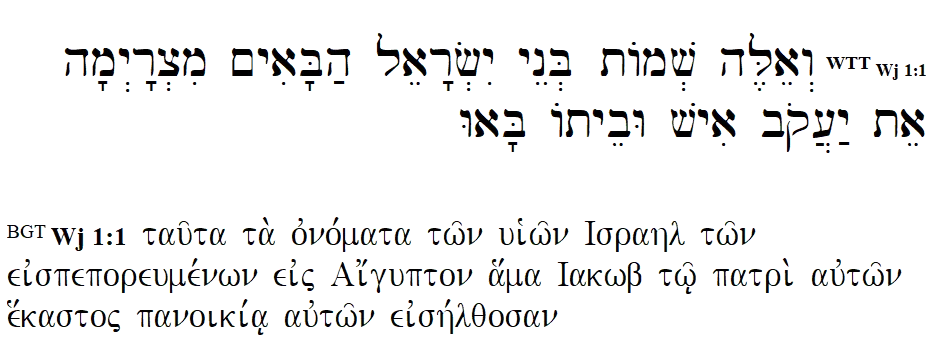
the following view will be seen:
hm'y>r"c.mi~yaiB'h; laer"f.yI ynEB. tAmv. hL,aew> WTTWj 1:1
WaB' AtybeW vyai bqo[]y: tae
BGT Wj 1:1 tau/ta ta. ovno,mata tw/n ui`w/n Israhl tw/n
eivspeporeume,nwn eivj Ai;gupton a[ma Iakwb tw/|
patri. auvtw/n e[kastoj panoiki,a| auvtw/n
eivsh,lqosan
If You see the below text
hm'y>r"c.mi ~yaiB'h; laer"f.yI ynEB. tAmv. hL,aew> WTTWj 1:1
WaB' AtybeW vyai bqo[]y: tae
BGT Wj 1:1 tau/ta ta. ovno,mata tw/n ui`w/n Israhl tw/n
eivspeporeume,nwn eivj Ai;gupton a[ma Iakwb tw/|
patri. auvtw/n e[kastoj panoiki,a| auvtw/n
eivsh,lqosan
as the second one from above, it’s worth to correct this defect.
To do this, You are asked to install the two fonts, having downloaded them Previously (they are offered without payment by the producer of the BibleWorks program) from the site:
http://www.bibleworks.com/ download.html
If You are not an expert in the installation of fonts, I will tell You how to do it one by one:
1. Download the fonts on Your desktop from this site:
http://www.bibleworks.com/ download.html
from the place: Free Greek and Hebrew Fonts (just below the beginning of this site)
2. Open the folder named Fonts in the Control Panel on Your computer.
You will see this (or similar) view of fonts on Your computer:
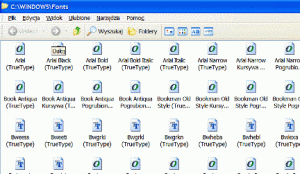
3. Reduce the window of this folder so that You can see this part of the desktop on which there are downloaded fonts!
NOTE: here I give an easy way to open the Fonts folder:
Click:
- Start (one click)
- Control Panel (one click),
- Switch to Classic View (one click)
(do it only when the icon “Fonts” didn’t appeare) - Fonts (two clicks, fast, one after another),
- But then do not forget to reduce the window “Fonts”!
 and
and  from the desktop to this folder (i.e., move the mouse to place the cursor on the “font picture” of the selected font, press the left mouse button and, keeping it pressed, move the mouse so that this image is moving toward the folder “Fonts”. When the image is somewhere within the folder “Fonts” then release the left mouse button). The same do for each “font picture”.
 5. After completing this simple step, You will see the Hebrew and Greek text correctly:
hm'y>r"c.mi ~yaiB'h; laer"f.yI ynEB. tAmv. hL,aew> WTTWj 1:1
WaB' AtybeW vyai bqo[]y: tae
BGT Wj 1:1 tau/ta ta. ovno,mata tw/n ui`w/n Israhl tw/n
eivspeporeume,nwn eivj Ai;gupton a[ma Iakwb tw/|
patri. auvtw/n e[kastoj panoiki,a| auvtw/n
eivsh,lqosan
Have You succeed? Good luck!
Dr. Wojciech Kosek
Charakterystyka zawartości niniejszej strony, jej słów kluczowych:
Adoration of Jesus – Jericho prayer. Installation of Greek and Hebrew fonts. If You want to know that it is worth to pray persistently after receiving the Holy Communion, during the meeting with Christ, read the text written by Dr. Wojciech Kosek, biblist. Install two fonts. And here are the words that bind this site with the main issues: God, Jesus, Christ, Holy Communion, Mass, Eucharist, Popes, saint, prayer, adoration, thanksgiving, kairos, faith, Christianity, Jericho prayer, fonts, Hebrew, Greek.